Table of Contents
Picture this: thousands of drivers, all making the smartest possible choice for themselves, creating the dumbest possible outcome for everyone. Welcome to your morning commute, where individual rationality collides with collective misery. The phenomenon has a name, and understanding it might not fix your commute, but at least you’ll know exactly why you’re late.
The Paradox Nobody Asked For
Here’s something that sounds impossible. A city builds a new road to ease congestion. Traffic gets worse. Not because of construction delays or poor planning, but because the new road exists at all. This isn’t hypothetical.
- It happened in New York City when officials closed 42nd Street for Earth Day in 1990. Traffic improved.
- It happened in Seoul when the city tore down a highway. Congestion decreased.
- Stuttgart, Germany removed a major road. Drivers got to their destinations faster.
The principle at work is called Braess’s Paradox, named after mathematician Dietrich Braess who discovered it in 1968. The paradox reveals something uncomfortable about how networks function when everyone acts in their own interest. Adding capacity to a network can reduce overall performance when users are free to choose their routes. The new option that looks attractive to individual drivers becomes overloaded precisely because it looks attractive. Everyone rushes to use the shortcut, turning it into a parking lot.
When Smart People Make Dumb Crowds
Game theory gives us the tools to understand this mess. Imagine a simple network with two routes from home to work. Route A is fast when empty but slows down dramatically with traffic. Route B is slower overall but maintains a steadier pace regardless of congestion. When just a few people are commuting, everyone picks Route A and breezes through. As more drivers join the system, Route A slows down until some people switch to Route B. Eventually, the system reaches an equilibrium where both routes take the same amount of time. Nobody can improve their commute by switching routes. Economists call this a Nash equilibrium, named after mathematician John Nash.
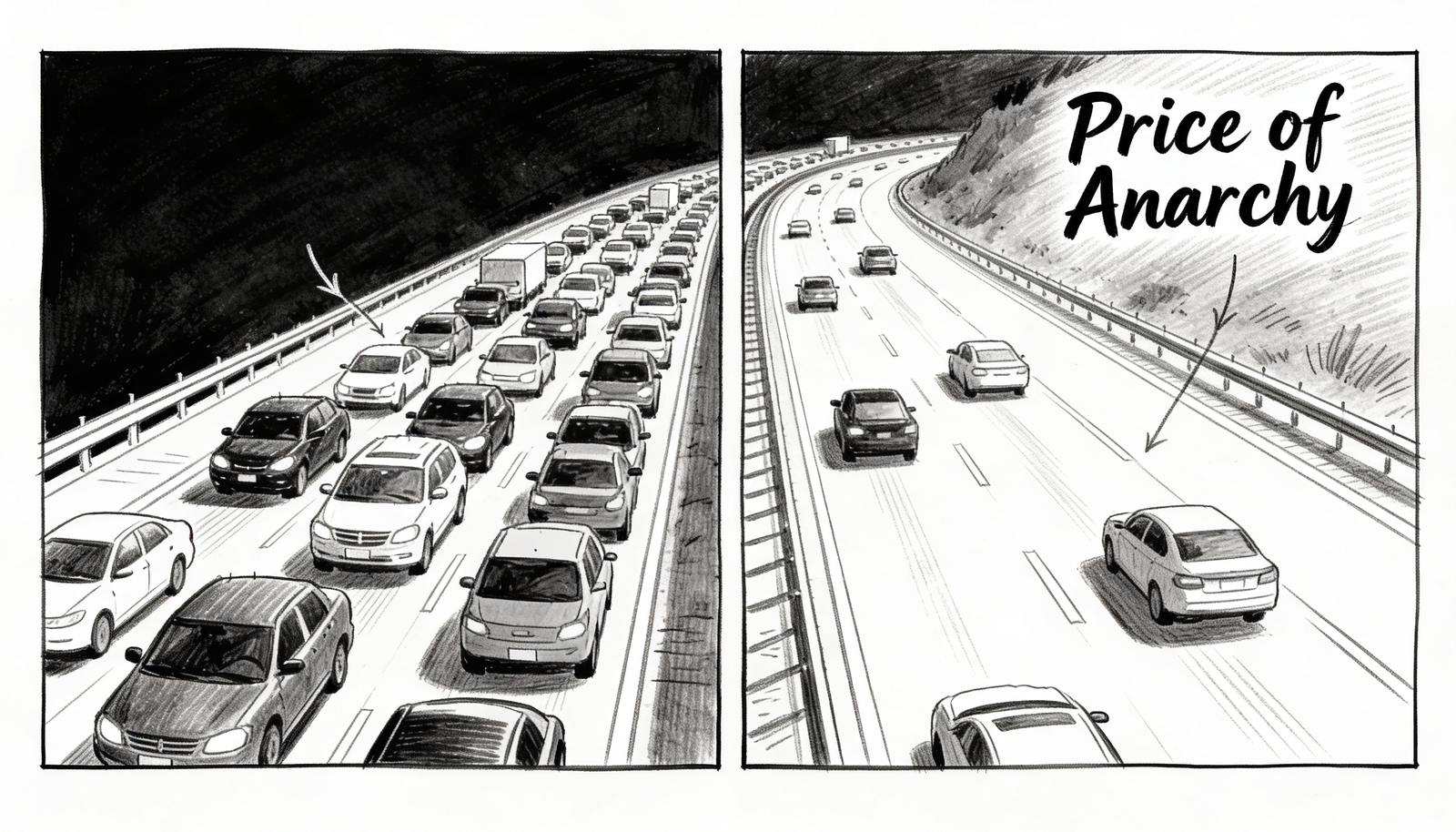
But here’s the twist. This equilibrium isn’t actually the best outcome. If drivers could coordinate perfectly, they could distribute themselves across both routes in a way that minimizes total travel time. The difference between what happens when everyone acts selfishly and what could happen with perfect coordination is the Price of Anarchy.
The term was coined by computer scientist Elias Koutsoupias and Christos Papadimitriou in 1999. They wanted to quantify exactly how much worse things get when systems rely on selfish behavior instead of central planning. The price is usually expressed as a ratio. If total travel time in the selfish equilibrium is 100 minutes and optimal coordination would achieve 75 minutes, the Price of Anarchy is 100/75, or about 1.33. Society pays a 33% penalty for freedom of choice.
The Highway Paradox Strikes Again
New roads create their own problems through a process called induced demand. Build more lanes and you attract more drivers. The new capacity fills up faster than anyone expects. This happens because driving becomes relatively more attractive compared to alternatives. Some people who took the train start driving. Others who avoided certain trips entirely now make them. Some who traveled during off hours switch to peak times. The system adapts, often eliminating the intended benefits.
The Katy Freeway in Houston offers a perfect case study. In 2008, officials widened it to 26 lanes in some sections, making it one of the widest highways in the world. The project cost billions and promised to solve congestion. Five years later, travel times during peak hours had increased by 30% compared to before construction. More lanes meant more drivers, and the Price of Anarchy maintained its grip.
What makes this particularly frustrating is that the opposite also works. Reduce road capacity and traffic often reroutes efficiently. Those threatened doomsday scenarios rarely materialize. Drivers adjust their routes, timing, or modes of transportation. The network finds a new equilibrium, sometimes a better one.
Your Brain On Traffic
The psychological element amplifies everything. Drivers consistently overestimate their ability to navigate traffic. Everyone thinks they know the secret shortcuts. Most are wrong, or would be wrong if everyone else knew the same shortcuts. Navigation apps changed the game by giving everyone access to the same information in real time. The apps optimize for individual travel time, sending cars down residential streets and through neighborhoods. Each driver gets marginally faster service. Residents get noise, danger, and frustration.
This creates a new kind of Price of Anarchy. The optimal route for an individual driver can impose costs on people not even participating in the system. The mom walking her kids to school on what used to be a quiet street now deals with cut through traffic. The homeowner sees property values affected by constant vehicle flow. The community experiences degraded quality of life because routing algorithms treat residential streets as pressure release valves for congested highways.
Loss aversion makes it worse. Drivers hate sitting still. A route that moves slowly but steadily feels better than one that alternates between cruising and stopping, even when the stop and go route is faster overall. This psychological quirk means drivers will choose routes that feel better even when data suggests otherwise. The perception of progress matters more than actual progress.
What Cities Can Actually Do
Understanding the problem suggests solutions, though none are simple. Congestion pricing works by making drivers pay for the costs they impose on others. When you choose to drive during rush hour, you slow down everyone else. A congestion fee forces you to internalize that externality.
The result is that drivers who still choose to pay the fee often get where they’re going faster than before. They’re paying for the privilege of less congestion. Those who switch to alternatives get better transit service funded partly by congestion fees. Everyone can win, though convincing voters to accept new fees remains politically challenging.
Removing roads is another option that sounds insane but works. When cities eliminate certain routes entirely, traffic adapts. The disappeared capacity doesn’t cause proportional increases in congestion elsewhere. Drivers modify their behavior, trips get consolidated, and the system recalibrates. This only works in urban areas with alternative transportation options. Rural highways operate under different rules.
Technology offers partial solutions. If autonomous vehicles ever dominate roads, they could coordinate perfectly. The cars could communicate with each other and optimize routing collectively rather than individually. The Price of Anarchy approaches zero when you eliminate selfish decision making. Of course, this requires trusting algorithms with human life and giving up personal control, which creates its own set of problems.
All of this raises philosophical questions about freedom, efficiency, and social organization. A perfectly coordinated system would be more efficient but requires either central control or unanimous cooperation. Neither seems realistic or maybe even desirable for large scale human societies. The Price of Anarchy represents the cost of freedom. It’s what we pay for letting individuals make their own choices rather than submitting to a central authority.
The Commute Continues
Tomorrow morning, thousands of drivers will wake up, check their apps, and choose what they believe are the fastest routes to work. Each decision will be individually rational. The collective result will be predictably inefficient. Travel times will exceed what’s theoretically possible. The Price of Anarchy will extract its daily tax.
The math doesn’t lie, and neither does experience. The morning commute will continue to suck not because people are dumb, but because they’re smart. Smart in isolation. Foolish in aggregate. Game theory predicted this decades ago. Traffic engineers understand it. City planners wrestle with it. And you’re stuck in it, inching forward, part of a system that generates the proof of its own inefficiency every single rush hour.
Understanding the Price of Anarchy won’t make traffic disappear. But maybe next time you’re sitting in gridlock, watching cars pack onto a highway that clearly cannot hold them all, you’ll appreciate the mathematical elegance of the disaster unfolding around you.
Small comfort, perhaps. But comfort nonetheless.