Table of Contents
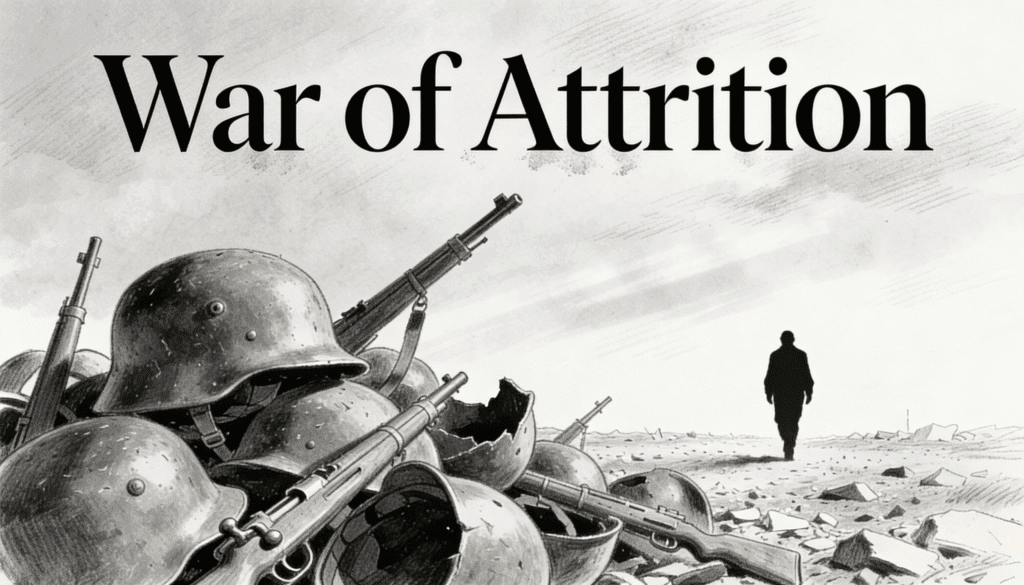
The most dangerous game in human conflict is not the swift strike or the brilliant maneuver. It is the grinding, brutal contest where both sides keep feeding resources into a meat grinder, each believing they can outlast the other. History calls these wars of attrition, and they reveal a peculiar truth: the logic that starts them is the same logic that makes them impossible to win.
Picture two people standing in a room, holding lit matches over their open palms. The rules are simple. Whoever drops their match first loses everything. The person who holds on longer wins everything. Both players know they will get burned. Both know the longer they wait, the worse the burn becomes. Yet both keep holding.
This is not stupidity. This is game theory in its purest, most unforgiving form.
The Trap That Looks Like Strategy
Wars of attrition emerge from a simple calculation that becomes catastrophic. Each side believes it has slightly more endurance, slightly more resources, or slightly more willingness to suffer than the opponent. The math seems straightforward: last one day longer than the enemy and you win. If they break first, everything you spent was worth it.
The First World War’s Western Front demonstrates this thinking with brutal clarity. Millions died for strips of mud measured in yards. Generals believed the next offensive would break the enemy’s will. Month after month, year after year, both sides kept feeding soldiers into the same killing grounds.
Neither side was irrational. Germany had superior tactics and interior lines. The Allies had superior resources and manpower. Each advantage seemed decisive until tested against reality.
The optimal strategy depends entirely on what the opponent does. If the enemy quits tomorrow, every resource spent today was justified. If the enemy never quits, everything spent was waste. The counterintuitive element is that both sides can make rational decisions at every step while producing an utterly irrational outcome.
Sunk Costs and the Gambler’s Fallacy
Once blood and treasure pour into a conflict, a second trap springs. How do leaders tell the families of the dead that their sacrifice was for nothing? How do they justify retreat when retreat means admitting every previous loss was avoidable?
Consider a nation that has lost 100,000 soldiers. Quitting now means those deaths accomplished nothing. Fighting on means there is still a chance to give those deaths meaning through victory. The rational choice might be to cut losses. The political choice is to continue.
This creates a ratchet effect. Each new casualty makes withdrawal more costly in emotional terms, even as it makes withdrawal more necessary in strategic terms. The longer the war continues, the harder it becomes to stop.
Vietnam presented this trap for nearly a decade. Each year brought new losses that made previous losses harder to abandon. The original goals became secondary to the need to not have fought in vain. Both sides face the same pressures, making their own sacrifices meaningful through continued commitment.
The Myth of the Breaking Point
Wars of attrition rest on a seductive idea: everyone has a breaking point. Apply enough pressure and the enemy will crack. This idea is not wrong. It is simply incomplete.
The assumption is that the enemy’s breaking point comes before your own. Yet both sides make the same calculation. Both cannot be right. More troubling, both can be wrong.
The Iran-Iraq War lasted eight years and killed perhaps a million people. Iraq believed Iran would collapse under military pressure. Iran believed Iraq would crumble first. Both bled themselves white. The war ended not because one side broke but because both accepted that breaking the other was impossible.
Suffering can harden resolve as easily as it can shatter it. A population that might have accepted peace terms at the start may refuse the same terms after years of sacrifice. In a war of attrition, showing weakness invites the enemy to press harder. Showing strength requires spending resources you may not have.
Each side tries to convince the other it has infinite resolve. But only costly signals are credible. The most credible signal of resolve is continuing to fight despite mounting losses. Which is precisely what makes wars of attrition self-perpetuating.
The Prisoner’s Dilemma at Scale
The deeper structure of wars of attrition mirrors the famous prisoner’s dilemma. Both sides would benefit from mutual de-escalation or negotiated settlement. Both sides fear that showing willingness to negotiate signals weakness that the opponent will exploit. The safest individual strategy is to keep fighting, which produces the worst collective outcome.
Imagine two exhausted boxers in the fifteenth round. Both are concussed, bleeding, and barely standing. Both know that continuing risks permanent damage. A draw would let both fighters walk away. But neither can propose a draw without looking weak. Neither can trust that a proposal would not be exploited. So they keep swinging.
This is not a failure of rationality. It is rationality producing an irrational result. Each boxer is correctly responding to the incentives they face. The structure of the game makes mutual destruction the logical outcome.
Historical examples abound. The Soviet Union and Germany on the Eastern Front from 1941 to 1945. Neither side could afford to stop fighting. Neither side could achieve decisive victory. The result was the bloodiest theater of the bloodiest war in human history. Millions died in a contest where both sides understood, at some level, that total victory was impossible.
The game theory here reveals something uncomfortable. The absence of a clear winner does not prevent the game from being played. Both sides can recognize they are trapped in a destructive pattern and still be unable to escape it. Individual rationality and collective rationality can point in opposite directions.
Why Winning Is Losing
The cruelest irony of wars of attrition is that victory and defeat become nearly indistinguishable. The winner is whoever is left standing after both sides have destroyed themselves. The prize is the privilege of having bled slightly less than the opponent.
Consider Pyrrhus of Epirus, whose victory over the Romans in 279 BCE cost him so many men that he reportedly said, “Another such victory and we are lost.” The phrase “Pyrrhic victory” entered language because it captures something essential about attritional warfare. You can win and still lose everything that made winning worthwhile.
The mathematics confirm the intuition. In a war of attrition, total costs to both sides increase over time. The winner is determined by who incurs slightly less total cost than the loser. But both sides pay far more than any realistic value of the prize being contested. The “winner” simply overpaid slightly less than the “loser.”
This creates a situation where rational actors can recognize they are in a losing game but cannot escape without losing even more. Continuing the war is costly. Abandoning the war means accepting that all previous costs were wasted. The least bad option is to continue, even knowing the total cost will exceed any possible benefit.
France in 1917 faced this calculation. The country was exhausted, the army mutinied, and victory seemed distant. But abandoning the fight meant German occupation and the waste of three years of sacrifice. So France fought on. The eventual victory in 1918 came at costs that shaped French society for generations.
The Exit Problem
Every war of attrition eventually ends. The question is how. Complete exhaustion is one option. Both sides reach a point where continuing is literally impossible. This happened in the Iran-Iraq War. Neither side won. Both simply stopped being able to fight.
External intervention is another. A third party imposes a settlement or changes the balance enough that one side can claim victory. The Korean War ended this way, with external powers forcing a stalemate that became permanent.
Internal collapse is a third. One side’s domestic politics shift enough that continuing becomes impossible regardless of the military situation. The Soviet withdrawal from Afghanistan followed this pattern.
The rarest outcome is negotiated settlement based on mutual recognition of futility. This requires both sides to simultaneously admit they cannot win. It requires leaders to value future peace over past sacrifice. It requires populations to accept that their losses were, in some sense, for nothing.
Wars of attrition end when something breaks the equilibrium, not when both sides decide to stop.
Lessons From the Game
Game theory teaches several truths about wars of attrition. First, they are easier to start than to stop. The decision to enter may be rational. The decision to continue becomes rational because of costs already incurred. The decision to stop becomes nearly impossible.
Second, individual rationality can produce collective catastrophe. Each decision maker choosing the best available option can result in outcomes that benefit no one.
Third, winners and losers are often indistinguishable. The side that endures longest wins only in the narrowest sense. Both pay prices that dwarf any conceivable prize.
Fourth, information problems make escape difficult. Both sides hide weakness and exaggerate strength. Both misread signals and overestimate their advantages.
Fifth, sunk costs trap rational actors. Resources already spent become justification for spending more. The hole gets deeper because stopping means admitting the digging was pointless.
The Modern Landscape
Contemporary conflicts increasingly take attritional forms. Nuclear weapons prevent total war between major powers. Asymmetric conflicts allow weaker parties to impose costs without facing decisive defeat.
The war in Ukraine exhibits attritional characteristics. Neither side can achieve quick victory. Both can impose significant costs. The conflict grinds on, not because either side has a clear path to triumph but because neither can accept the terms available through negotiation.
Afghanistan demonstrated attrition over two decades. The Taliban could not be eliminated. The result was a slow drain of resources until the domestic costs exceeded the perceived benefits.
These are structural features of how modern conflicts unfold. When both sides can survive but neither can win decisively, attrition becomes the default state.
The Human Element
Behind the mathematics are people. Soldiers who fight. Families who grieve. Economies that strain. Societies that fracture.
A war of attrition measures time in casualties. Territory in graveyards. Progress in degrees of exhaustion. The strategic goal becomes tactical endurance. Victory becomes abstract. Survival becomes concrete.
Yet humans remain capable of choosing differently. Leaders can prioritize future peace over past sacrifice. Populations can demand change. Negotiations can succeed when both sides recognize mutual interest in stopping.
The challenge is that these choices require exactly what wars of attrition destroy: the ability to think beyond the immediate contest, to value something more than not losing, to accept imperfect outcomes.
The Final Calculation
Wars of attrition have no winners because winning requires costs that exceed any reasonable value of victory. They have only survivors because survival becomes the only achievable goal once the logic of attrition takes hold.
Game theory illuminates this trap with merciless clarity. The mathematics show how rational actors pursuing reasonable goals can lock themselves into catastrophic outcomes.
The lesson is not that war is irrational. The lesson is that certain types of conflict create rational incentives that lead to irrational results. The attrition game is a trap precisely because it looks winnable to both sides until both are already caught.
Understanding the game does not guarantee escaping it. But it offers a warning. When two sides begin trading casualties in pursuit of breaking the opponent’s will, they have entered a contest where the winner’s prize is having lost less than the loser. Where survival is victory and victory is survival and both are purchases made at prices too high to justify.
The burned hands holding the matches eventually drop them. But by then, the damage is done. The game is over. And both players limp away wondering why they kept holding on so long.