Table of Contents
The best move in any game is often the one nobody sees coming. Not because it’s brilliant, but because it’s random.
This runs counter to everything we’re taught. We optimize our lives for certainty. We build systems, create habits, and follow best practices. We want the right answer, the proven method, the data-driven decision. And yet, there’s a whole class of situations where the person who refuses to be pinned down wins, while the person with the perfect strategy loses.
Game theory calls this a mixed strategy. The rest of us might call it organized chaos.
The Goalkeeper’s Dilemma
Picture a penalty kick in soccer. The goalkeeper stands on the line. The kicker places the ball. For a moment, the entire stadium holds its breath. The kicker has studied this goalkeeper. He knows that he dives right 60% of the time. The data is clear. The optimal move is to kick left.
But here’s where things get interesting. If that data exists, the goalkeeper knows it exists too. He knows the kicker has watched the tapes. He knows he’s going to kick left. So he should dive left, right?
Not exactly.
If he always dives left when facing this particular kicker, he’ll adjust. Next time, he’ll blast it right into the empty net. So he needs to keep him guessing. He needs to be just predictable enough that the data seems useful, but just random enough that acting on that data becomes dangerous.
This is the essence of a mixed strategy. It’s not about finding the best move. It’s about making sure your opponent can never be quite certain what you’ll do next.
When Right Becomes Wrong
Most decisions in life aren’t like penalty kicks. If you’re building a bridge, there’s a right way and many wrong ways. You don’t want the engineer to surprise you with a creative interpretation of load-bearing requirements. Predictability in bridge building is called safety.
But strip away the physical world and enter any domain where you’re in direct competition with thinking opponents, and the rules change completely. Markets. Negotiations. Sports. Warfare. Dating. Politics. Anywhere there’s another mind trying to predict yours, optimization becomes a trap.
Consider the poker player who only bets big when holding strong cards. This player knows the math. He understands pot odds and expected value. He never makes a bad bet. He’s right every single time. And he’s broke.
Why? Because everyone at the table can read him like a billboard. When he pushes chips forward, they fold. When he checks, they bet. His perfect logic has made him perfectly exploitable.
The winning player does something that looks insane to the outside observer. He bets big on garbage hands. He folds premium cards. He makes moves that, in isolation, are objectively wrong. But these “mistakes” aren’t errors. They’re investments in unpredictability. Each bad bluff pays dividends by making future good bluffs believable.
Rock, Paper, Scissors and the Myth of Skill
Children play rock, paper, scissors. Adults think they’ve outgrown it. But this simple game contains a profound truth that most strategic thinking misses entirely.
There is no best move in rock, paper, scissors. Rock doesn’t beat paper more often than scissors does. Paper isn’t stronger than scissors. The game is perfectly balanced. And yet, people lose at it consistently.
They lose because they create patterns. They throw rock too often after losing. They avoid the same throw twice in a row. They think they’re being clever. Their opponent doesn’t need to be clever to beat them. Their opponent just needs to notice the pattern.
The only unbeatable strategy is to randomize completely. Throw rock exactly one third of the time. Paper one third. Scissors one third. Make each throw independent of the last. Become a random number generator.
This sounds boring. It is boring. It’s also optimal.
Here’s the irony: the way to win at rock, paper, scissors against most humans is to be slightly less random than pure randomness would dictate. Watch for their patterns and exploit them. But the way to avoid losing against any opponent, no matter how skilled, is to be perfectly random. You might not win, but you can guarantee you won’t lose.
Most competitive situations sit somewhere between these extremes. You can’t be perfectly random because you have actual constraints and costs. But you can’t be perfectly optimized because that makes you perfectly predictable.
The Curious Case of the Tennis Serve
Professional tennis offers another window into this paradox. Servers can aim for two general areas: the returner’s forehand or backhand. Most players have a weaker side. The data shows it. Everyone knows it.
So why don’t servers always target the weak side?
Because the returner knows it’s weak too. They cheat that direction. They prepare for it. Hit the weak side too often and it stops being weak. The returner positions for it. They expect it. What was a weakness becomes a trap.
The optimal serving strategy involves regularly hitting to the strong side precisely because it’s strong. These serves lose points more often. They’re worse serves. But they keep the weak side weak by preventing the returner from camping there.
This is where mixed strategies become counterintuitive. You make bad moves on purpose. You take worse options intentionally. Not because you’re confused or making mistakes, but because making some mistakes is the only way to keep your good moves good.
The Price of Patterns
Humans are pattern-making machines. We can’t help it. Show someone a sequence of random coin flips and ask them to continue it, and they’ll create patterns. Heads, tails, heads, tails. Or three heads then switch. We avoid repeating ourselves. We balance things out. We think in rhythms.
This makes us terrible at randomness. And terrible at mixed strategies. It creates exploitable patterns.
The math doesn’t care about your last choice. But human psychology does care. We want variety. We seek balance. We think “surely not three times in a row.”
And that’s exactly what makes us predictable.
There’s something deeply unsatisfying about mixed strategies. They require accepting that sometimes you should make the worse choice. They demand that you give up on finding the “right” answer because there isn’t one.
Imagine a general planning a military operation. Intelligence suggests the enemy expects an attack from the north. The southern route is less defended. The data is clear. Every instinct says go south.
A pure optimization approach says attack south every time. But if the enemy knows you optimize, they know you’ll attack south. So they move their forces. Your perfect strategy walks into a trap.
The mixed strategy says maybe attack north 30% of the time, even though it’s worse. Not because you’re unsure. Not because you lack information. But because certainty is a weakness when facing an intelligent opponent.
This feels wasteful. Those northern attacks will likely fail more often. Commanders will die in battles you knew were lower percentage. How do you explain that to their families? “We attacked the more heavily defended position to maintain strategic unpredictability”?
And yet, the alternative is worse. Perfect predictability means perfect defeat. The enemy simply waits where you must go and crushes you.
The Business of Bluffing
Markets run on similar principles. A company that always cuts prices when inventory builds becomes predictable. Competitors let them build inventory, knowing the sale is coming. Customers wait for the predictable discount. The optimized response destroys its own value.
Tech companies sometimes release products that seem nonsensical. Features nobody asked for. Services that don’t fit their brand. Markets they have no expertise in. Analysts call these mistakes. Sometimes they are.
But sometimes they’re strategic randomness. They keep competitors guessing. They prevent the market from fully modeling the company’s decision tree. When your next move could be anything, rivals can’t optimize against you. They have to prepare for multiple scenarios. That preparation has costs.
The company pays the cost of the weird product. Competitors pay the cost of uncertainty.
The Limits of Unpredictability
None of this suggests chaos for chaos’s sake. A company that’s random about product quality fails. A bridge builder who randomizes structural decisions kills people. A doctor who flips coins for diagnoses should lose their license.
Mixed strategies apply in adversarial situations where your opponent benefits from predicting you. They don’t apply when you’re fighting nature or physics or disease. Cancer cells don’t adjust their behavior based on your chemotherapy patterns. Gravity doesn’t care if you always drop things at the same time.
The distinction matters. In cooperative situations or when facing non-adaptive challenges, optimization wins. Learn the best practice. Follow it. Get predictably good results.
But the moment another intelligence enters the equation and starts trying to model you, pure optimization becomes vulnerable. The person who always negotiates the same way loses to the person who varies their approach. The investor who follows a rigid system gets exploited by those who’ve decoded it. The team that runs the same plays gets shut down.
Randomness as Strategy
True randomness is actually quite hard to achieve. Computers use complex algorithms to generate pseudo-random numbers. Humans are worse at it than computers. We cluster. We pattern. We avoid repetition when randomness would repeat.
This creates opportunities. Casinos know that humans playing roulette will avoid betting on red after a long streak of red, even though the odds haven’t changed. The ball doesn’t remember what color it landed on last.
But it also creates vulnerabilities. The trader who thinks they’re varying their strategy might be following a pattern they can’t see. The poker player who mixes up their play might do it predictably, raising with weak hands only in late position, or only against certain opponents.
Real unpredictability requires systems. Poker players memorize random number tables. Military planners use dice or random number generators for certain tactical decisions. Athletes work with coaches to ensure their patterns of play don’t emerge.
The irony is that being truly unpredictable requires discipline and planning. Spontaneity isn’t random. It’s just a different kind of pattern.
The Advantage of Constraints
Sometimes real-world constraints do what random strategies try to achieve artificially. A soccer player with a weak left foot can’t effectively aim for both corners equally. This seems like a disadvantage. Often it is. But occasionally, that constraint provides cover for randomness.
When the player occasionally goes left despite the weakness, opponents can’t tell if it’s strategic unpredictability or just a mistake. The imperfection itself becomes harder to exploit because it’s unclear whether it’s intentional.
This doesn’t make weaknesses good. But it suggests that perfect execution of a mixed strategy might be less effective than imperfect execution that looks like human fallibility.
Why This Matters Beyond Games
The applications extend far past sports and poker. Anyone trying to negotiate a salary needs to be somewhat unpredictable about their bottom line. State it clearly and the employer optimizes right to that edge. Keep it mysterious and they have to guess, hopefully guessing higher than necessary.
Parents dealing with children need to avoid perfect consistency in discipline. The child who knows exactly how many times they can break a rule before consequences arrive will break it exactly that many times.
Even personal productivity has elements of this. Always work on the hardest task first and you’ll start avoiding starting. Build in some randomness, some days where you do easy tasks first, and you can’t procrastinate by knowing your pattern.
Being unpredictable feels wrong because we’ve spent our entire lives being taught that consistency equals virtue. Show up at the same time. Follow the same process. Build reliable habits. These are good things in many contexts.
But they’re exploitable in competitive ones.
The supreme irony of mixed strategies is that they work best when nobody knows you’re using them. Announce that you’re being deliberately random and you give away the game. Your opponent knows to stop looking for patterns and to treat each of your moves as independent.
The best mixed strategies look like human inconsistency. They look like mistakes, changes of heart, spontaneity. They hide in plain sight as apparent imperfection.
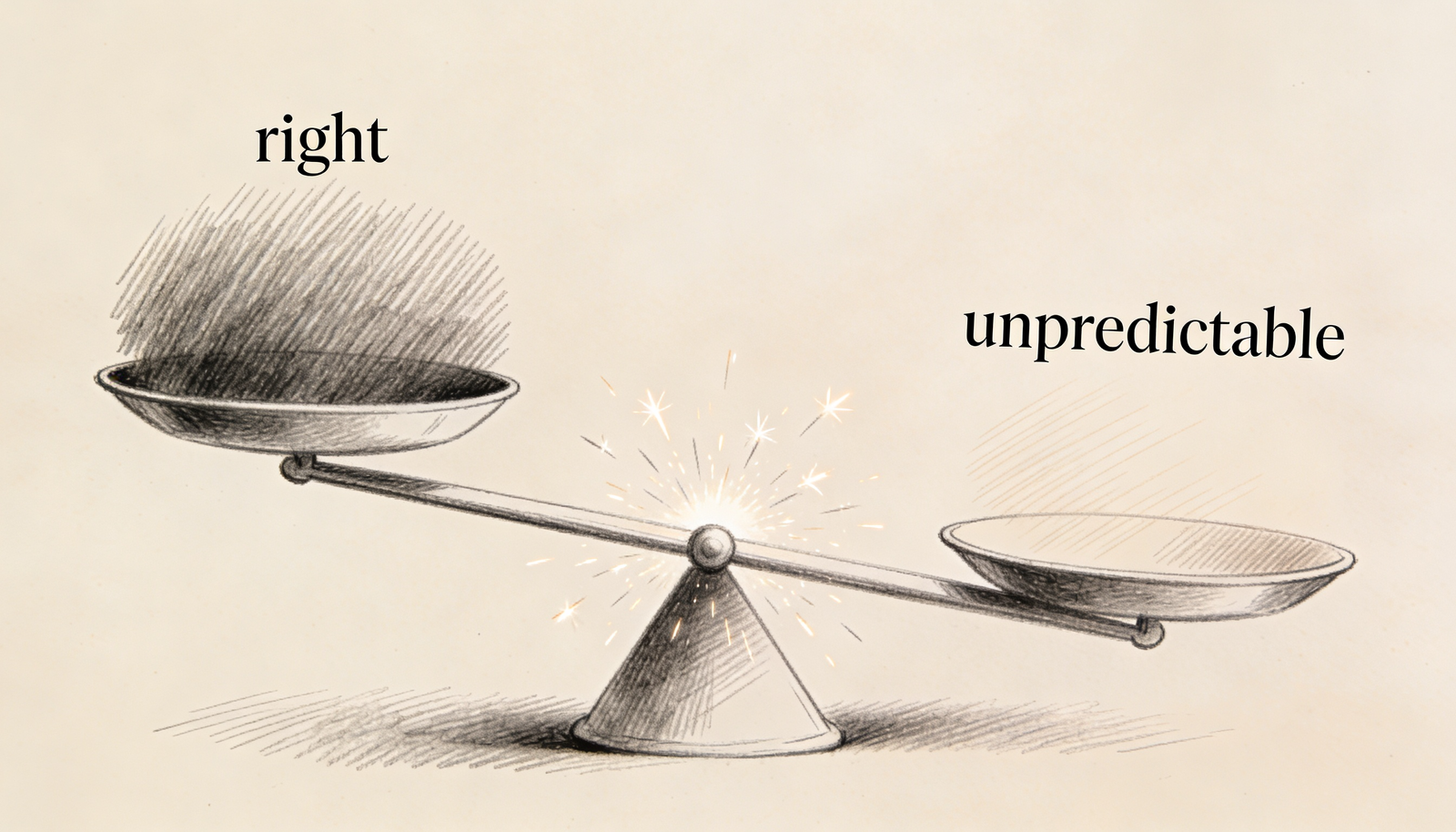
So perhaps the real lesson isn’t to be random. It’s to be comfortable with choices that look wrong in isolation but work as part of a larger pattern of unpredictability. To accept that the right move might be the worse move, if it keeps your opponent guessing.
In a world obsessed with optimization, unpredictability might be the last unoptimizable advantage. Everyone’s trying to find the best approach, the perfect system, the right answer. And they’re all becoming predictable in the process.
Maybe the winning move is to stop looking for it.