Table of Contents
Democracy rests on a beautiful promise: the people choose, and the system delivers what they want. Put everyone’s preferences into the machine, turn the crank, and out comes the collective will. Simple, elegant, fair.
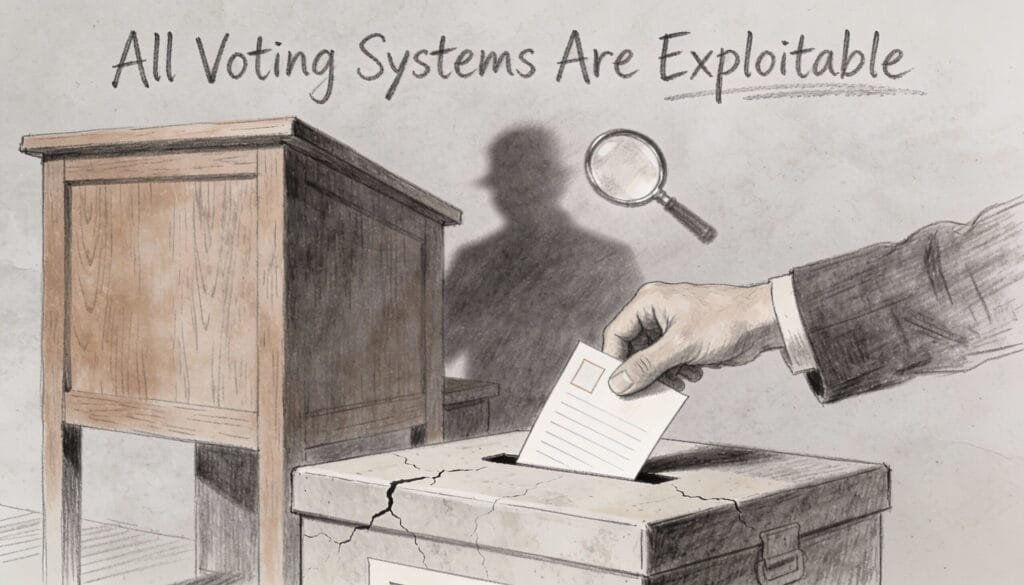
Except mathematicians discovered something disturbing. Every voting system we could ever design contains a fatal flaw. Not some systems. Not most systems. Every single one.
This isn’t a political argument or a philosophical debate. It’s a mathematical certainty, proven in 1973 by economists Allan Gibbard and Mark Satterthwaite working independently. Their theorem shows that any voting system allowing three or more outcomes can be manipulated by strategic voters. The only exceptions are dictatorships, where one person decides everything, or systems so restrictive they’re useless.
Think of it as democracy’s uncertainty principle. We can have a system where everyone votes honestly, or we can have a system that produces good outcomes, but we cannot have both at once.
The Game Everyone Plays
Voting seems straightforward until you examine it through game theory’s unforgiving lens. Each voter becomes a player in a game where the prize is getting their preferred outcome. The rules are the voting system itself. And like all games, players quickly learn that honesty isn’t always the best strategy.
Consider a city council choosing between three budget proposals: high spending, moderate spending, and low spending. Thirty council members will vote. Ten prefer high spending above all. Ten want moderate spending. Ten insist on low spending.
Under simple plurality voting, where each person picks one option and the most votes win, the moderate budget looks doomed. Each faction will vote for their favorite. The vote splits three ways, ten to ten to ten. A tie.
But wait. The high spending faction realizes something clever. They actually prefer moderate spending to low spending. If they pretend to support moderate spending instead of revealing their true preference, the vote becomes twenty for moderate, ten for low, zero for high. The moderate budget wins.
The high spenders just manipulated the system. They lied about their preferences and got a better outcome than honesty would have delivered. Game theory calls this strategic voting, though “strategic lying” might be more accurate.
The Theorem’s Brutal Elegance
Gibbard and Satterthwaite didn’t just notice that some voting systems could be gamed. They proved something far more unsettling: gaming the system is always possible.
Their theorem establishes three conditions. If a voting system meets the first two, it must violate the third:
First, the system must allow at least three possible outcomes. This seems reasonable. Most real decisions involve more than two choices.
Second, the system cannot be a dictatorship. One person shouldn’t decide everything for everyone. Also reasonable.
Third, the system must be strategy proof, meaning voters cannot benefit by lying about their preferences. Honesty should always be the best policy.
The theorem proves you can only pick two. Want three or more outcomes without a dictator? Then strategic manipulation becomes inevitable. Want strategy proof voting without a dictator? You can only choose between two outcomes. Want three outcomes with honest voting? Welcome to dictatorship.
Mathematics doesn’t care about our ideals. The proof is airtight.
Why This Happens
The reason voting systems break down connects to a deeper mathematical truth about aggregating preferences. When you try to combine different people’s rankings into a single collective ranking, contradictions emerge.
Imagine three friends choosing a restaurant. Alice prefers Italian over Chinese over Mexican. Bob prefers Chinese over Mexican over Italian. Carol prefers Mexican over Italian over Chinese.
They vote on pairs. Italian versus Chinese: Alice and Carol vote for Italian, so Italian wins. Chinese versus Mexican: Alice and Bob vote for Chinese, so Chinese wins. By this logic, Italian should beat Mexican, right? Italian beats Chinese, Chinese beats Mexican, so Italian should triumph over Mexican.
But when they actually vote Italian versus Mexican, Bob and Carol vote for Mexican. Mexican wins.
The group’s preferences form a cycle. Italian beats Chinese beats Mexican beats Italian beats Chinese beats Mexican, forever. There is no consistent “will of the people” here. The collective preference doesn’t exist in any meaningful sense.
This is the Condorcet paradox, discovered in 1785. It reveals why designing fair voting systems is mathematically impossible. The preferences we’re trying to aggregate don’t always combine into something coherent.
Strategic voting exploits these inconsistencies. When the rules create situations where honesty produces absurd outcomes, lying becomes rational.
The Prisoner’s Dilemma in the Ballot Box
Game theory’s most famous puzzle casts light on voting’s strategic darkness. In the prisoner’s dilemma, two criminals face a choice: cooperate with each other by staying silent, or betray each other by confessing. If both stay silent, both get light sentences. If one confesses while the other stays silent, the confessor goes free while the silent one gets a heavy sentence. If both confess, both get moderate sentences.
The rational move is confessing. No matter what the other prisoner does, you’re better off talking. But when both prisoners think this way, both confess and both end up worse off than if they had cooperated.
Strategic voting creates the same trap. When everyone votes honestly, the outcome might be acceptable to most people. But any individual voter who switches to strategic voting can improve their personal outcome. So everyone switches to strategic voting, and the outcome becomes worse for everyone.
Picture an election with three candidates: Left, Center, and Right. Most voters slightly prefer Center but have strong feelings about Left versus Right. The honest vote might elect Center, the consensus choice. But Left voters fear Right might win, so they strategically support Center. Right voters fear Left might win, so they also strategically support Center.
Wait, that actually produces the desired outcome. The problem occurs when the strategic calculations shift. If enough Left voters think Center can’t win, they might strategically vote for Right to prevent Left from winning… no, that makes no sense. Let me reconsider.
Actually, imagine Left voters prefer Left, then Center, then Right. Right voters prefer Right, then Center, then Left. Center voters split between preferring Left second or Right second.
Under honest voting, Left gets thirty-five percent, Center gets thirty percent, Right gets thirty-five percent. Left wins by a hair.
But the Right voters realize that if they lie and vote for Center, they get Center instead of their nightmare scenario where Left governs. So Right voters strategically choose Center. Now Center wins with sixty-five percent.
This seems fine until the Left voters catch on. They realize Right voters are voting strategically. So Left voters also vote strategically for Center to block Right from executing the same strategy in reverse next time. Now everyone lies, trust erodes, and the voting system becomes a game of multi-level deception.
The honest equilibrium was unstable. Once strategic voting begins, it spreads like a virus.
Real World Casualties
These aren’t just theoretical problems. Every voting system used in actual democracies falls victim to the theorem.
Plurality voting, used in the United States and United Kingdom, famously suffers from strategic voting. Supporters of minor candidates face a dilemma: vote honestly for their favorite who cannot win, or vote strategically for a viable candidate they merely tolerate. The phrase “don’t waste your vote” encapsulates this manipulation.
The 2000 United States presidential election provides a stark example. Ralph Nader won 97,488 votes in Florida. George Bush won the state by 537 votes over Al Gore. Nader voters likely preferred Gore to Bush, but their honest votes helped elect their least preferred candidate. Strategic voting would have meant lying and voting for Gore.
Ranked choice voting seems like an improvement. Voters rank all candidates, and if nobody wins a majority, the least popular candidate gets eliminated and their votes transfer to voters’ second choices. This continues until someone has a majority.
Surely this fixes strategic voting? It doesn’t. The Gibbard-Satterthwaite Theorem still applies.
In a ranked choice election, strategic voters might rank a weak opponent of their favorite candidate higher than that candidate deserves. This helps the weak opponent defeat the strong opponent in early rounds, making the final round easier for the strategic voter’s true favorite.
Score voting, where voters rate each candidate on a scale, also fails. Strategic voters give maximum scores to acceptable candidates and minimum scores to everyone else, turning score voting into approval voting. Once everyone adopts this strategy, the nuance that made score voting appealing vanishes.
Even exotic systems like Condorcet methods, which try to find candidates who would beat all others in head to head contests, remain vulnerable. Strategic voters can manipulate which candidates face each other by changing their rankings.
The Counter-Intuitive Twist
Here’s what makes the theorem deeply strange: adding more democratic features makes the manipulation worse.
You might think giving voters more freedom to express preferences would reduce strategic voting. If voters can rank candidates, or score them, or indicate intensities of preference, surely that creates more honest outcomes than simple plurality voting?
The opposite happens. More expressive voting systems create more opportunities for strategic manipulation. The additional information voters can provide becomes additional tools for deception.
Simple yes or no votes on a single question are actually the most strategy proof systems possible. Binary choices largely avoid the theorem’s curse. But binary choices also avoid solving complex problems with multiple possible solutions.
This creates a brutal tradeoff. We can have simple, relatively honest voting on simplistic questions. Or we can have complex, sophisticated voting on complex questions that invites manipulation. We cannot have both sophistication and honesty.
Democracy wants to hear the rich, complex preferences of millions of people and synthesize them into coherent policy. The theorem proves this ambition contains a mathematical contradiction.
Living With the Impossible
So what do we do with this knowledge? We can’t fix the problem. The math is ironclad. But we can understand what we’re dealing with.
First, recognize that all voting systems are broken in this specific way. Arguments about which voting system is “best” miss the point. They’re all exploitable. The question is which failures we can tolerate.
Plurality voting fails by punishing voters who support minor candidates. Ranked choice voting fails by creating complex strategic calculations about elimination order. Score voting fails when everyone strategically inflates their ratings. Pick your poison.
Second, understand that strategic voting isn’t cheating. It’s rational behavior in a broken system. When the rules create incentives to lie, you can’t blame players for lying. Blame the game, not the players.
Third, accept that voting outcomes don’t always represent some coherent “will of the people.” Sometimes the collective preference doesn’t exist. The voting system creates an outcome, but that outcome might not correspond to anything deeper than the mechanical application of arbitrary rules.
This sounds nihilistic. It’s actually liberating.
Once you accept that voting systems are imperfect tools rather than sacred rituals that divine the public’s true desires, you can focus on practical questions. Which system produces acceptable outcomes most of the time? Which system is easiest to understand? Which system creates the right incentives even if it can be manipulated?
The Gibbard-Satterthwaite Theorem doesn’t mean democracy is worthless. It means democracy is hard. The problems voting tries to solve genuinely difficult problems about aggregating conflicting preferences from millions of people. No perfect solution exists because the mathematics of the situation forbids perfect solutions.
The Dictatorship Exception
The theorem allows one exception: dictatorship. If one person makes all decisions, strategic voting becomes impossible. There’s nobody to manipulate.
This exception reveals something important. The problem with voting systems isn’t that they fail to identify some objective “right” answer. The problem is that they try to combine many subjective opinions into one collective choice, and that combination process inevitably creates exploitable rules.
A dictator doesn’t solve this by making better decisions. A dictator solves it by ignoring everyone else’s opinions. No aggregation, no paradoxes, no strategic manipulation. Also no democracy.
We reject dictatorship not because it’s mathematically flawed but because giving one person absolute power produces terrible outcomes. Better to have exploitable voting systems than efficient tyranny.
The theorem ultimately reveals a beautiful truth about democracy. We accept mathematical imperfection because involving everyone in decisions matters more than technical correctness. The mess, the manipulation, the strategic voting? That’s the price of letting everyone have a say.
The Game We Choose to Play
Game theory reveals voting as a multiplayer strategic game with no perfect solution. Every move creates opportunities for counter moves. Every rule creates incentives to break it.
But here’s the thing about games: we keep playing them anyway.
Chess is a solved game in principle. Perfect play by both sides leads to a draw. This doesn’t make chess meaningless. It makes chess interesting. The gap between perfect play and human play creates the entire game.
Voting systems are similar. They’re mathematically flawed, inevitably exploitable, guaranteed to produce strategic manipulation. And yet democracy keeps working, more or less, most of the time.
Perhaps the Gibbard-Satterthwaite Theorem isn’t democracy’s death certificate. Perhaps it’s democracy’s operating manual. A reminder that the system is fragile, that rules create incentives, that mathematical perfection is impossible, and that we should design institutions with their flaws in mind rather than pretending those flaws don’t exist.
The theorem proves that all voting systems are exploitable. It doesn’t prove which system we should use, or whether democracy works, or whether strategic voting destroys civic trust. Those remain open questions, immune to mathematical proof, requiring human judgment.
Which brings us full circle. Mathematics can prove voting systems are imperfect. But mathematics cannot choose our leaders, set our policies, or decide our future. We still need to vote.
The game theory is clear: strategic manipulation is always possible. The political theory is equally clear: we have to play the game anyway.
So we vote, knowing the system is broken, knowing others are voting strategically, knowing the outcome might not represent any coherent collective will. We vote because the alternative is letting someone else decide. We vote because flawed democracy beats every alternative.
The Gibbard-Satterthwaite Theorem proves that democracy cannot be perfected. Which means democracy will never be finished. The work continues, the game continues, the voting continues.
Mathematics shows us the limits of what’s possible. Democracy is what we do anyway.