Table of Contents
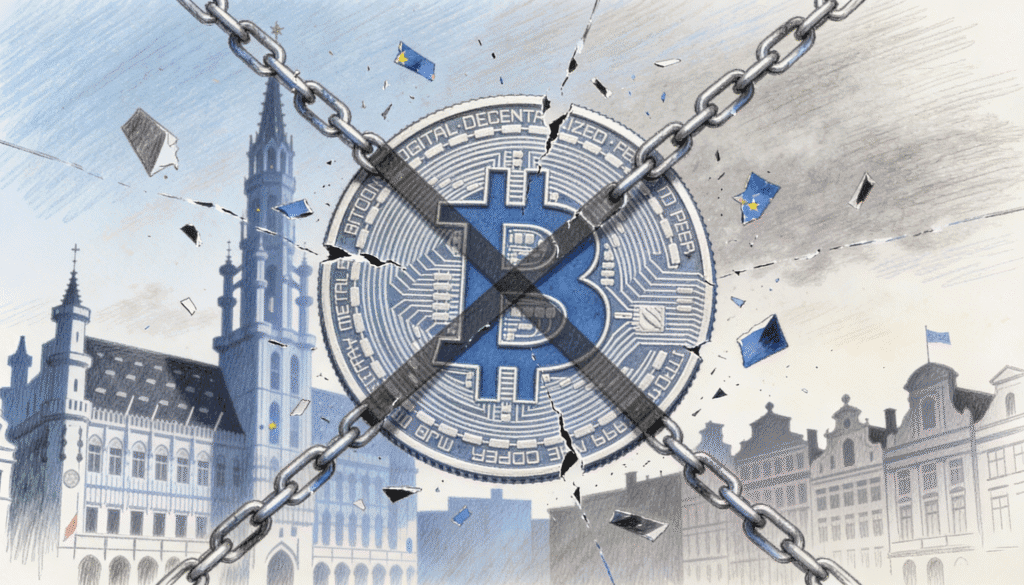
The European Union just proposed banning all cryptocurrency transactions with Russia. Every single one. No exceptions, no entity lists, no surgical strikes. Just a wall.
On the surface, this looks like the most aggressive move Brussels has made against Moscow’s financial infrastructure since the war began. It is the centrepiece of the EU’s 20th sanctions package, announced on February 6, 2026. Read that number again. Twenty. That alone should tell you something about how the previous nineteen have gone.
Because if you read the Commission’s own internal documents carefully, what they are really saying is not “we have found the perfect tool.” They are saying “we have run out of precision.”
The Game Nobody Is Winning
To understand why this matters, it helps to think about sanctions the way game theorists think about repeated games. A repeated game is any situation where two players interact over and over, each round learning from what the other did last time. The critical insight is simple: a strategy that works once will not keep working if your opponent is paying attention.
The EU sanctioned Garantex, a Russian crypto exchange the US flagged in 2022 for being the go to platform for cybercriminals and ransomware gangs. The logic was clean. Identify the bad actor, cut it off, move on. That is how sanctions have always worked against banks, oligarchs and shipping companies. Find the name, add it to the list, freeze it out.
In March 2025, an international law enforcement operation finally shut Garantex down for good. Domains seized, $26 million in crypto frozen, one of its administrators arrested in India. A clean win. For about a week.
Within days, Garantex’s founders launched Grinex, a new exchange registered in Kyrgyzstan. By the end of its first two weeks, Grinex had processed over $40 million in volume. Blockchain analytics firms found that billions of roubles worth of a stablecoin called A7A5 had been transferred directly from Garantex wallets to Grinex wallets before the shutdown even happened. The operators had seen the move coming and prepositioned their exit.
This is not a bug in the sanctions system. This is what happens when you play a static strategy against a dynamic opponent. You make your move. They observe it, learn from it, and adapt. You are playing chess. They are playing evolution.
The Hydra Admission
The European Commission’s internal document proposing the blanket ban contains a remarkable sentence: “Any further listing of individual cryptoasset service providers is therefore likely to result in the set up of new ones to circumvent those listings.“
Read that again. The EU is explicitly admitting that its own targeted approach creates the conditions for its own failure. Every time they cut off one head, two more grow back. They have essentially described a hydra and concluded that the only option left is to try and drain the swamp.
This is not a small admission. For years, the philosophy behind Western sanctions has been precision. Smart sanctions. Targeted measures. The idea was always that you could hurt the regime without hurting ordinary people, and you could do it with a scalpel rather than a hammer. The blanket crypto ban is a hammer.
There is a concept in game theory called mechanism design, which asks: instead of playing the game better, can you change the rules of the game itself? That is what Brussels is attempting. Rather than trying to identify and block each new Russian exchange as it appears, they want to make it illegal for any EU entity to interact with any crypto service provider established in Russia. Period.
It is elegant in theory. The logic goes: if you cannot predict where the next exchange will pop up, stop trying to predict. Just make every possible interaction illegal and shift the burden to compliance teams across Europe. In practice, it also means the EU has stopped trying to win the cat and mouse game and decided to ban mice altogether.
The $100 Billion Stablecoin That Would Not Die
The story of A7A5 shows why they felt they had no choice.
A7A5 is a stablecoin pegged to the Russian rouble. It is connected to a platform called A7, which US authorities say is controlled by sanctioned individuals including a Moldovan oligarch named Ilan Shor and the Russian state bank Promsvyazbank. The US, UK and EU have all imposed restrictions targeting the entities behind it.
None of that stopped A7A5 from crossing $100 billion in aggregate transaction volume. For context, that is larger than the GDP of about 130 countries. A stablecoin created with apparent Russian state support, operated through a web of Kyrgyz shell companies, openly defied the combined enforcement power of the world’s largest economies.
The 19th sanctions package in October 2025 tried a more targeted approach. The EU banned transactions involving A7A5 specifically, sanctioned the developer, the Kyrgyz issuer, and the operator of the main platform where it traded. It even introduced a clever legal definition of “mirror or successor entities” to prevent sanctioned exchanges from simply rebranding.
It was not enough. As Transparency International’s Russian branch documented, the sanctioned infrastructure had already morphed into a decentralised system of Telegram bots, agency contracts, and offshore payment processors. Every time regulators cut off one head of what the researchers called a “crypto hydra,” another appeared under a new name.
So now the EU wants to ban the entire species.
Why the Blanket Ban Might Fail Too
Here is where it gets counterintuitive. The blanket ban might be both the right move and a move that does not work.
Start with the obvious problem: crypto was designed to resist exactly this kind of control. When China banned all crypto transactions in 2021, trading did not stop. It migrated to peer to peer platforms, decentralised exchanges and over the counter markets. The volume found new channels the way water finds cracks.
A Carnegie Endowment analysis published in December 2025 made the case bluntly: the main victims of the EU’s sweeping crypto restrictions will not be the sanctioned Russian entities, who have already adapted, but ordinary Russians and small EU businesses doing legitimate trade. Russian companies with connections to the Kremlin had long ago built complex schemes involving third countries, offshore companies and nonpublic entities. The people who get hurt are the ones without the resources to build workarounds.
There is a painful irony here. By making legal channels so difficult, you create more demand for exactly the kind of shadow infrastructure the sanctions are trying to eliminate. The EU wants to drain the swamp, but the water has to go somewhere.
What This Really Tells Us
Zoom out from the technical details and you see a broader pattern that applies far beyond Russia and crypto.
Every enforcement system faces the same fundamental tension. The more precisely you target bad actors, the easier it is for them to identify and exploit the gaps. But the more broadly you ban everything, the more collateral damage you cause and the more you push activity into channels you cannot see at all.
Biologists call this an evolutionary arms race. Antibiotics kill bacteria; bacteria evolve resistance; we need stronger antibiotics; bacteria evolve again. The key lesson from biology is that you never reach a stable endpoint. You are always running. And critically, the organism under pressure often ends up stronger than it was before the pressure was applied. There is no reason to think financial sanctions work differently.
The EU’s 20 packages in four years are the sanctions equivalent of this cycle. Every round is a response to the last round’s failure. The intervals between packages have shortened. The language has escalated. The tools have gotten blunter. The blanket crypto ban is not a victory lap. It is an acknowledgement that the targeted approach has been outpaced by an adversary that moves faster, adapts quicker, and has fewer institutional constraints.
That does not mean doing nothing is better. It means understanding what sanctions can and cannot accomplish. They can raise costs. They can slow things down. They can make life harder. What they cannot do is stop a determined, adaptive adversary from finding a way through.
The EU is not wrong to try. But it is worth being honest about what this blanket ban actually represents. It is not a breakthrough. It is the sound of a system admitting that precision failed and hoping that brute force will do better.
Whether that honesty makes the policy more or less effective is, like most things in a repeated game, something we will only find out in the next round. And if the pattern holds, there will likely be a 21st package. And a 22nd. Each one a little broader, a little blunter, and a little more revealing about the limits of what rules can do when the other side does not play by them.