Table of Contents
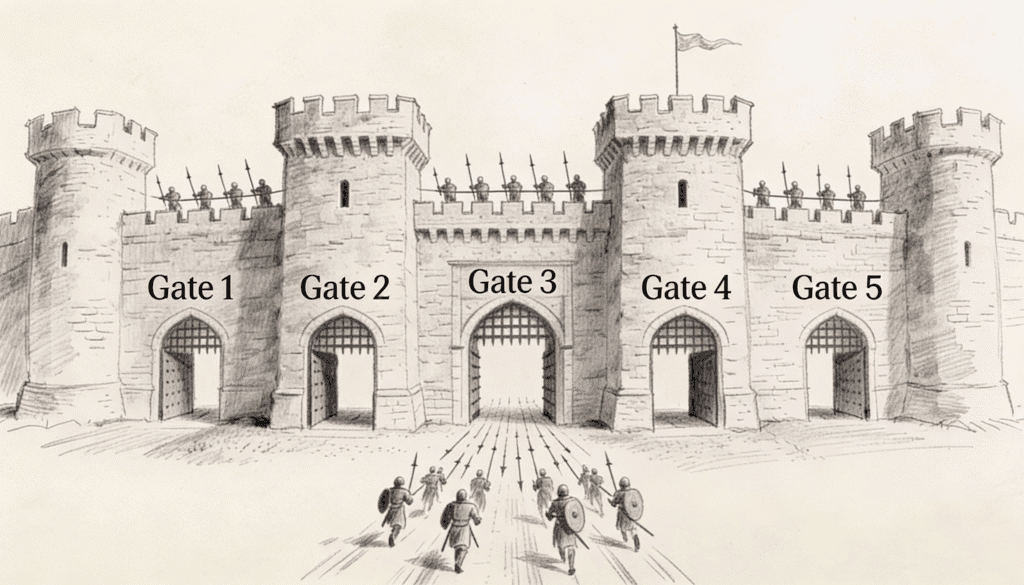
Picture a medieval castle under siege. The lord has one hundred soldiers. Five gates need defending. The enemy also has one hundred soldiers and will attack those same five gates. Here’s the catch: whoever puts more soldiers at a gate wins that gate. Win three gates and you win the castle.
Simple enough, right? Put twenty soldiers at each gate and call it a day.
Except the enemy isn’t splitting their forces evenly. They’re putting all one hundred soldiers at gate number three. They’ll lose the other four gates by default, but they’ll win gate three and… wait, that doesn’t work either. That’s only one gate. They need three.
Welcome to the Blotto Game, where the obvious strategy is usually wrong and overthinking becomes survival.
The General’s Puzzle
The Blotto Game, named after a fictional colonel, emerged from military strategy discussions over a century ago. Economists Émile Borel and John von Neumann helped formalize it, though the core problem has plagued commanders since ancient times. The setup remains beautifully brutal: two opponents, limited resources, multiple battlefields. Whoever controls more battlefields wins.
What makes this more than just a math problem is its perfect reflection of reality. Companies competing for market share across different regions. Political candidates allocating campaign funds across swing states. A student distributing study time across five final exams. An immune system deploying white blood cells against multiple infections simultaneously.
The resources are always scarce. The fronts are always multiple. The opponent is always thinking.
Why Equal Splits Fail
The tempting solution spreads resources evenly across all battlefields. Twenty soldiers per gate. Even odds everywhere. Fair and balanced.
This strategy has one fatal flaw: it loses to almost everything else.
Imagine the enemy puts thirty soldiers at three gates and five soldiers at the remaining two. They win those three critical gates and claim victory. The defender’s twenty soldiers at each gate meant winning nowhere decisively. The attacker sacrificed two battles they never intended to win anyway.
This reveals the first counterintuitive truth: trying to compete everywhere guarantees you’ll dominate nowhere.
The equal split strategy treats all battles as equally important. But in Blotto, only the majority of battles matter. Winning five battles narrowly is identical to winning three battles overwhelmingly and abandoning the other two. Both outcomes produce victory. One uses far fewer resources.
The Unpredictability Advantage
So if equal splits fail, what works?
Here’s where the game gets interesting. There is no single best strategy. There is only unpredictability.
Consider two players who face each other repeatedly. If one player develops a pattern, concentrating forces at battlefields one, three, and five, the opponent adapts. Next round, the opponent abandons those battlefields entirely, stacking everything on two and four. The patterned player suddenly finds their overwhelming forces conquering empty ground while losing the war.
The optimal approach involves randomization. Sometimes concentrate everything on three battlefields. Sometimes spread thinly across four while abandoning one. Sometimes create a lopsided distribution with huge force at one location, moderate force at two others, and breadcrumbs at the rest.
Think of it like rock paper scissors, but with a hundred fingers instead of three. Any predictable sequence gets exploited. Any pattern becomes a weakness. The only defense against a thinking opponent is strategic chaos.
The Weak Link Paradox
Here’s another twist that defies intuition: sometimes your weakest position matters most.
Suppose both players adopt similar strategies, concentrating roughly equal forces at three battlefields while leaving two vulnerable. The outcome at those three contested battlefields becomes nearly random due to similar force levels. But those two abandoned battlefields? Whoever left slightly more soldiers there claims them by default.
This creates the weak link paradox. Victory sometimes hinges not on where you were strongest but on where you were less weak than the opponent. A battlefield with five soldiers beats a battlefield with zero soldiers just as decisively as five hundred beats four hundred.
Smart players recognize this and engage in a bizarre form of strategic minimalism at certain locations. Put just enough to beat probable enemy minimums. It’s like bidding one dollar more than the next highest bidder at an auction. Efficiency replaces overwhelming force.
Real Battlefields
The Blotto Game might sound academic until you notice it everywhere.
Political campaigns demonstrate this constantly. A presidential candidate has limited money, time, and energy. Fifty states need attention, but only a handful swing states actually matter. Pour resources into safe states and waste them. Ignore winnable states and lose opportunities. Spread too thin across all swing states and get outspent in each one.
The winning strategy? Identify the minimum number of states needed for victory. Abandon truly safe states with minimal presence. Forget about states the opponent has locked down. Then concentrate resources across just enough swing states to secure an electoral majority, while randomizing the exact allocation to prevent opponents from perfectly countering.
Businesses face identical pressures. A company launches a product across multiple markets. Each market demands marketing budget, sales teams, inventory, and customer support. Spreading resources equally across all markets means mediocre performance everywhere. Concentrating on select markets means dominance there but complete absence elsewhere.
The strategic question becomes: which markets matter most, and how much can we afford to lose in others?
The Escalation Trap
One dangerous tendency in Blotto scenarios is escalation. Two competitors pour resources into the same battlefields, matching each other’s commitments. Both recognize a critical front. Both refuse to concede it.
This creates a black hole that swallows resources while producing stalemate.
Sports teams show this pattern clearly. Two rivals identify the same star free agent. Both keep increasing their contract offers. The bidding escalates beyond the player’s actual value. The winning team “wins” by overpaying. The losing team loses by wasting negotiation time and energy. Both would have benefited from recognizing the escalation trap earlier and redirecting resources elsewhere.
The smarter play often involves recognizing when a battlefield becomes too expensive to contest. Concede it. Accept the loss there. Redeploy those resources where the opponent isn’t looking.
Of course, your opponent knows this too. They might feint interest in a battlefield, hoping you commit resources to defend it, then abandon that battlefield entirely while you waste strength on an empty threat. The psychological dimension adds layers of complexity beyond pure mathematics.
Asymmetry Changes Everything
The basic Blotto Game assumes equal resources. One hundred soldiers each. Identical constraints. Balanced opposition.
Reality rarely cooperates.
What happens when one side has one hundred soldiers and the other has one hundred fifty? The mathematical elegance collapses into messy pragmatism.
The stronger player can afford to match the weaker player’s maximum possible concentration at three battlefields while still having resources left for the others. This seems to guarantee victory. And it would, if the weaker player fought conventionally.
But resource disadvantages force creativity. The weaker player cannot win by matching strength against strength. Instead, they must exploit the stronger opponent’s predictability or arrogance. Concentrate everything at fewer battlefields than the opponent expects. Abandon more fronts than seems reasonable. Win the absolute minimum needed for victory while accepting certain defeats elsewhere.
History loves these stories. Smaller forces defeating larger ones through unconventional allocation. The few against the many. It sounds romantic until you realize the smaller force usually loses. The times they win, they win by refusing to play the expected game.
The Information Game
Everything discussed so far assumes simultaneous moves. Both players commit their forces without knowing the opponent’s allocation.
Real competition often involves sequential moves or partial information. One company enters a market first. Another responds. The first company sees that response and adjusts. Markets evolve in view of all players.
This transforms the Blotto Game entirely. Moving second provides enormous advantage. See where the opponent committed forces, then optimize your allocation to exploit their weaknesses. They put heavy resources at battlefields one and two? Concede those and dominate three, four, and five.
But moving first has advantages too. Force the opponent into a reactive posture. Make them respond to your choices rather than implementing their ideal strategy. Set the terms of competition.
The information dimension adds new layers to resource allocation. How much should you reveal about your commitments? Can you credibly threaten certain allocations to manipulate opponent behavior? Should you make binding commitments early to force opponent adaptation or maintain flexibility until the last moment?
The Time Element
Most discussions of the Blotto Game treat it as a one-time event. Allocate forces, resolve battles, determine winner, end game.
But real strategic competition repeats. The same opponents face each other across time. Resource allocation becomes not just about this battle but about establishing patterns and reputations across many battles.
A player who always abandons certain battlefields becomes predictable. Opponents exploit that pattern. But a player who varies their strategy perfectly randomly never develops the reputation effects that can deter enemy aggression.
Consider this scenario: a company consistently neglects a market segment. Competitors notice and invade that segment. The company must either defend it (diverting resources from elsewhere) or accept permanent loss of that market. If the company had shown willingness to defend all markets unpredictably, competitors might have hesitated before attacking.
Reputation becomes a resource itself. The perception that you might defend any battlefield strongly creates deterrence effects that save actual resources. But maintaining that perception requires occasionally defending unexpected positions, even at significant cost, just to prove you can.
Why Optimization Fails
Engineers and analysts love optimization. Given constraints and objectives, calculate the optimal solution. Execute that solution. Win.
The Blotto Game reveals why optimization alone fails in competitive environments.
Any optimized strategy assumes something about opponent behavior. Even sophisticated mathematical models require assumptions about what opponents will do. If those assumptions prove wrong, the “optimal” strategy becomes deeply suboptimal.
More importantly, optimization tends toward specific, deterministic solutions. Do exactly this at battlefield one, exactly that at battlefield two. The precision makes the strategy vulnerable. Opponents notice patterns. They exploit them.
True strategic thinking in Blotto-style situations requires accepting suboptimality. Deliberately randomize. Make choices that look inefficient in isolation. Avoid perfect solutions that create perfect predictability.
This frustrates people who want clear answers. What’s the right way to allocate these resources? There isn’t one. There are many possible allocations, and the best approach involves mixing among them unpredictably.
The Defender’s Disadvantage
Military theorists often claim defense enjoys inherent advantages. Defenders know the terrain. They prepare positions. Attackers must expose themselves.
The Blotto Game suggests otherwise.
Defenders must cover all possible attack points. Attackers choose where to attack. This asymmetry favors offense. The attacker concentrates forces at chosen locations while the defender spreads forces across all potential targets.
A company defending market share across ten product categories must maintain presence in all ten. A challenger can focus resources on just three categories, dominate those, and build from there.
This explains why established companies often lose to focused startups despite vastly superior resources. The defender protects everything. The attacker threatens select targets. The defender spreads thin. The attacker concentrates.
The defensive counter requires giving up the illusion of defending everything. Accept losses in some areas. Concentrate defense on truly vital positions. Let the periphery go.
But which positions are truly vital? That judgment separates successful defenders from failed ones.
Lessons From Chaos
The Blotto Game teaches several uncomfortable lessons.
First, you cannot defend everything. Resources are finite. Trying to protect all fronts equally protects nothing effectively. Strategic triage becomes mandatory.
Second, unpredictability beats optimization. The perfect plan becomes a perfect target. Randomness and variation create survival.
Third, focusing resources concentrates power but creates vulnerability elsewhere. This tradeoff is inescapable. The art lies in choosing which vulnerabilities to accept.
Fourth, information and timing matter as much as raw resources. Knowing opponent commitments or moving at the right moment multiplies effective strength.
Fifth, repeated competition changes optimal strategy. Short term wins might create long term weaknesses. Patterns become traps.
The deepest lesson might be this: strategic thinking requires accepting fundamental uncertainty. There is no formula guaranteeing victory. No perfect allocation exists independent of opponent choices. The best strategies remain flexible, adaptive, and comfortable with controlled chaos.
Beyond the Battlefield
The Blotto Game started as military theory but explains far more than warfare. Any situation involving limited resources, multiple objectives, and competition reflects this dynamic.
Personal decisions mirror it too. Limited time and energy spread across career, relationships, health, hobbies, rest. Trying to excel everywhere simultaneously guarantees mediocrity across all areas. Success requires choosing where to concentrate effort and accepting reduced performance elsewhere.
The person who wants to be an Olympic athlete, Fortune 500 CEO, award-winning novelist, and perfect parent faces a Blotto Game against reality itself. Resources get allocated. Something gives. The only question is whether the allocation is deliberate or accidental.
Organizations face it constantly. Finite budget across countless needs. Innovation versus efficiency. Growth versus stability. Customer satisfaction versus profit margins. Every resource committed to one objective is unavailable for others.
The framework helps clarify these tradeoffs. Not by providing easy answers but by revealing the structural nature of the dilemma. You cannot optimize for everything. You cannot defend all positions. You cannot satisfy all stakeholders fully.
Strategic thinking means deciding what to give up.
The Acceptance of Loss
Perhaps the most difficult aspect of the allocation dilemma is accepting built-in losses.
Human psychology resists this. Losing feels like failure. Giving up territory seems like surrender. Abandoning battlefields appears cowardly.
But in Blotto-style situations, chosen losses enable chosen victories. Deliberately losing battles you don’t need to win preserves resources for battles you must win. This is strategy, not surrender.
The castle lord who puts zero soldiers at two gates isn’t surrendering those gates. He’s acknowledging he only needs three gates to win and concentrating force where it matters. Those two gates were lost the moment he decided three others were more important.
This reframe changes everything. Losses aren’t failures but resource allocation choices. The question isn’t whether to lose but where to lose and whether those losses accomplish something valuable.
A company exiting a market isn’t necessarily failing. It might be reallocating capital from low-return markets to high-return ones. A person declining opportunities isn’t necessarily scared. They might be protecting resources for commitments they value more.
Of course, sometimes losses are actual failures. The trick is knowing the difference. Chosen strategic losses serve larger goals. Unchosen failures result from inadequate resources or poor execution.
The Game Continues
The Blotto Game has no final answer. Mathematicians have proven that optimal play involves mixed strategies and randomization, but they cannot specify a single best allocation.
This frustrates people who want formulas. But it also liberates strategic thinking from false certainty. There is no perfect solution waiting to be discovered. There is only the ongoing challenge of allocating scarce resources against thinking opponents who adapt to your choices.
Every player brings limited resources to multiple battlefields. Every allocation creates both strength and weakness. Every opponent seeks to exploit those weaknesses while protecting their own. The competition never truly ends. It evolves.
In a world of unlimited resources, the Blotto Game wouldn’t exist. Everyone could dominate everywhere simultaneously. But resources are always scarce. Battlefields are always multiple. Opponents are always present.
The allocation dilemma isn’t a puzzle to solve. It’s a condition to manage. The players who manage it best don’t find perfect answers. They ask better questions. They choose their battles carefully. They accept their losses deliberately. They keep their opponents guessing.
And they understand that defending everything means defending nothing.