Table of Contents
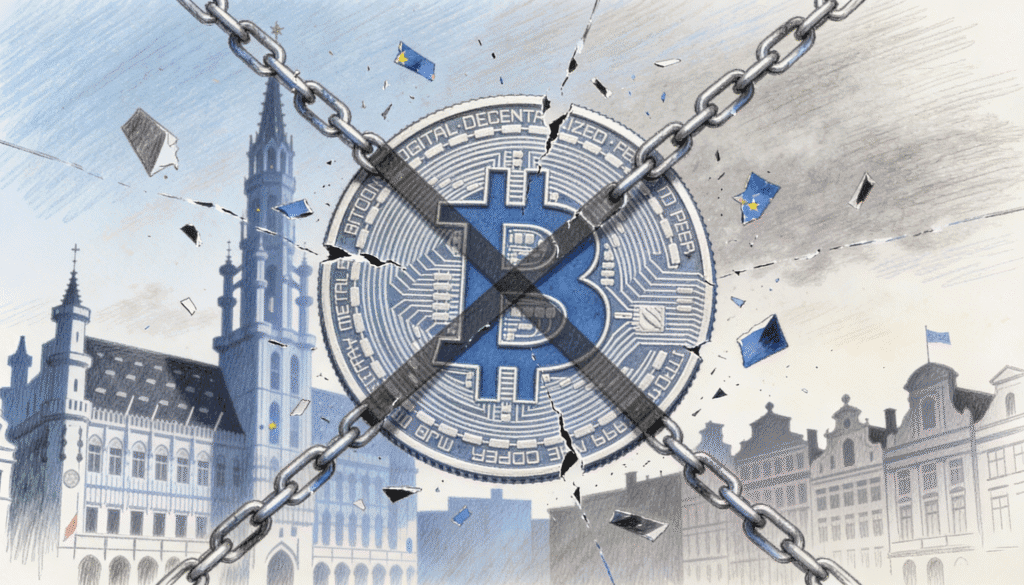
There is a moment in every multiplayer game when one player realizes the rules no longer protect them. Not because the rules changed, but because the other players stopped pretending to follow them. That is the moment Emmanuel Macron is describing when he talks about “the Greenland moment.” And whether you find Macron persuasive or performative, his diagnosis contains a game theory puzzle worth taking apart.
The Prisoner’s Dilemma Nobody Agreed To
The classical prisoner’s dilemma assumes both players understand they are in a game. Europe’s problem is stranger. For decades, the EU operated as if the global economic order was a repeated cooperative game. The logic was sound on paper: if major economies keep trading fairly, keep respecting institutions like the WTO, and keep honoring mutual dependencies, everyone benefits over time. Cooperation is the rational long term strategy in repeated games. Retaliation is reserved for defectors.
But what happens when your two biggest trading partners both defect at the same time?
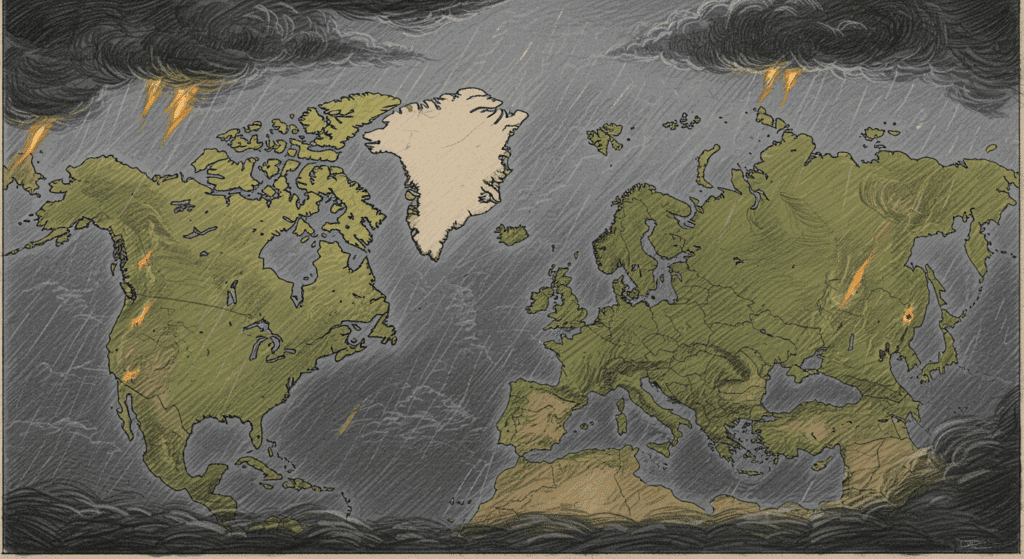
China floods European markets with subsidized goods. The US threatens punitive tariffs over an Arctic island and signals it may weaponize tech regulation disputes. Suddenly Europe is not playing a repeated cooperative game. It is playing two simultaneous games of chicken against opponents who have already decided to swerve in unpredictable directions.
This is the core tension Macron is articulating, even if he frames it in the language of sovereignty rather than strategy. The EU built its entire economic architecture around the assumption that the game would stay cooperative. Institutions, rules, multilateral frameworks. These are all tools for sustaining cooperation in repeated games. They become liabilities when the game shifts to something more adversarial.
The Credibility Problem
Game theory is obsessed with credible threats. A threat only works if the other side believes you will actually follow through. This is where Europe has a structural weakness that no amount of summit communiqués can fix overnight.
Macron says the EU should not “bow down” to the Trump administration. He calls for “European preference” policies and massive common debt for innovation. These are bold strategic proposals. But credibility in game theory does not come from what you say. It comes from what you can visibly commit to doing.
The EU’s decision making process is itself a game. Twenty seven member states with different interests, different threat perceptions, and different economic models must agree before the bloc can act. This is common knowledge among Europe’s rivals. When Trump pressures individual EU countries over Greenland, he is exploiting exactly this: the knowledge that Europe’s collective response mechanism is slow, fractured, and subject to internal vetoes.
Compare this to how the US or China can act. A single decision maker (or a tightly controlled political system) can commit to a course of action quickly and visibly. The EU cannot. So even when Macron proposes the right strategic response, every outside player can reasonably discount its likelihood of implementation. The threat is not credible because the commitment mechanism is weak.
This is not just a political observation. It is a fundamental game theoretic disadvantage. In any negotiation, the side that can credibly commit to walking away or retaliating holds power. The side that has to hold an internal committee meeting before responding does not.
The Paradox of Protection
Macron’s call for “buy European” policies and protecting critical value chains introduces another game theory dimension: the tension between internal cooperation and external competition.
Here is the counterintuitive part. The EU single market is itself a cooperative equilibrium among member states. Countries agreed to lower internal barriers, allow free movement of goods and services, and resist the temptation to protect national champions. This internal cooperation is what makes Europe collectively powerful.
But “European preference” policies risk destabilizing that internal game. When France pushes for protecting European car manufacturers, it is not a neutral policy. It benefits some member states far more than others. Countries with smaller industrial bases may see this as France using collective European language to advance French industrial interests. And they would not be entirely wrong to think so.
This creates a nested game problem. To compete externally, the EU needs internal unity. But the policies required to compete externally can undermine internal unity. Macron needs the very countries that are skeptical of industrial policy to agree to industrial policy. The game within the game makes the outer game harder to win.
The FCAS Situation: A Miniature of the Larger Failure
Perhaps nothing illustrates Europe’s game theory dysfunction more clearly than the Franco German fighter jet debacle. The Future Combat Air System was supposed to be the flagship of European defense cooperation. Instead, it has become a textbook example of what game theorists call a “hold up problem.”
Once both countries committed resources and political capital to the project, each became vulnerable to the other’s demands. Dassault and Airbus, the contractors involved, are now engaged in what Macron himself describes as trying to “game the system.” They are exploiting the sunk costs and political commitments to extract better terms for themselves.
Macron’s warning is telling: if Germany questions the joint aircraft, France will question the joint tank. This is pure tit for tat, the classic strategy in repeated games. But it also reveals something uncomfortable. Even between Europe’s two most important partners, cooperation defaults to mutual hostage taking rather than genuine alignment.
If France and Germany cannot solve a bilateral coordination game on defense, the idea that 27 member states will coordinate an “economic revolution” requires a certain optimism that game theory does not support.
The Free Rider Cathedral
Macron’s push for common EU debt to fund AI, energy, and defense investments runs into the oldest problem in collective action theory: free riding.
If the EU collectively borrows to invest in quantum computing, every member state benefits from the resulting capabilities. But the costs and risks of that debt are distributed unevenly. Countries with stronger fiscal positions bear more risk. Countries with weaker ones get a subsidy they could not access alone.
This is not inherently unfair. But it creates a dynamic where every country has an incentive to support the investment in principle while bargaining hard to minimize their own contribution. The result is what we see repeatedly in EU negotiations: grand ambitions announced at summits, followed by years of watering down during implementation.
The irony is that the external threats Macron describes should theoretically solve the free rider problem. When a common enemy is visible, the incentive to cooperate increases. Wars, pandemics, and economic shocks historically overcome collective action failures because the cost of not cooperating becomes unbearable.
But “the Greenland moment” may not be painful enough. Trump’s tariff threats recede temporarily. Chinese goods are cheap and consumers like cheap things. The urgency that should force cooperation evaporates just quickly enough for each member state to return to protecting its own narrow interests. Macron essentially admits this when he warns against letting your guard down after a crisis peaks.
The Information Game with Tech Regulation
Macron’s prediction that the US will “attack” Europe over digital regulation opens yet another strategic front. And this one involves a different kind of game: an information asymmetry contest.
European tech regulation, from data privacy to the Digital Services Act, is fundamentally about controlling information flows. The US tech industry’s business model depends on minimizing those controls. When Macron frames children’s online safety as sovereignty (“our children’s brains are not for sale“), he is reframing a trade dispute as a values contest.
This is strategically smart. In game theory terms, it changes the payoff matrix. If the dispute is purely economic, Europe might rationally concede to avoid tariffs. But if the dispute is framed as protecting children, concession becomes politically toxic. No European leader wants to be seen as selling out children’s safety for trade convenience.
The question is whether this reframing holds under pressure. The US has a long history of converting values disputes into trade disputes, where raw economic leverage matters more than moral framing.
What Would a Rational EU Actually Do?
If you set aside politics and just think about this as a strategy problem, the EU’s optimal play is not complicated to describe. It is just extremely difficult to execute.
First, reduce internal veto points so external threats can be met with credible, fast responses. Second, invest in genuine strategic autonomy in sectors where dependency creates vulnerability. Third, accept that some internal free market principles will need to bend when external competitors are not playing by market rules. Fourth, stop announcing grand projects that visibly fail (like FCAS) because each failure reduces the credibility of the next commitment.
The problem is that each of these steps is itself a game among member states with conflicting interests. Europe does not lack strategy. It lacks the institutional architecture to execute strategy against players who move faster and commit harder.
Macron sees this clearly. His frustration is palpable because he has been saying some version of this since 2017. But seeing the game clearly and being able to play it well are very different things. The chessboard is visible to everyone. The pieces just refuse to move in coordination.
And that may be the most important game theory lesson of all. In multiplayer games, the smartest analysis means nothing if you cannot get your own team to act on it. Europe’s greatest opponent is not in Washington or Beijing. It is in the 27 capitals that must agree before a single move is made.