Table of Contents
Tomorrow never comes, the saying goes. But what if tomorrow always comes? What if the game never ends?
This simple shift transforms everything. The mathematics that govern our choices flip upside down when we move from single encounters to infinite repetition. The Folk Theorem captures this transformation, showing how the shadow of countless tomorrows can turn selfish actors into cooperators, liars into honest dealers, and strangers into partners.
The theorem itself carries an ironic name. Unlike most mathematical results that bear the names of their discoverers, the Folk Theorem earned its title because nobody could quite pin down who proved it first. The insight seemed to emerge from the collective consciousness of game theorists in the 1950s and 1960s, passed along in seminars and coffee shop conversations until it became common knowledge. A theorem about reputation built its own reputation through word of mouth.
The One Shot Problem
Picture two merchants in a marketplace. Each can sell quality goods or cheap knockoffs at the same price. Quality costs more to produce. If both sell quality, they each make a modest profit. If one sells junk while the other maintains standards, the cheater makes a fortune while the honest merchant loses money. If both peddle garbage, they both break even as customers flee the market entirely.
This is the famous Prisoner’s Dilemma wearing merchant robes. The rational move, the Nash equilibrium, points toward mutual defection. Both merchants should sell junk. Each merchant reasons: whatever the other does, selling low quality items puts more money in the pocket. If the other sells quality, cheating yields maximum profit. If the other cheats, cheating at least avoids the sucker’s payoff of maintaining standards while getting undercut.
So both cheat. Both end up with nothing. The tragedy writes itself.
Traditional game theory, analyzing this single interaction, predicts a dismal outcome. Cooperation crumbles before it begins. Trust never forms. The mathematics seems to doom us to a world of mutual defection.
Except that markets exist. Merchants do cooperate. Reputation matters. Something in the real world defies what the simple model predicts.
When Tomorrow Matters
The Folk Theorem reveals what changes the game. Repetition.
Imagine the merchants meet not once but every week, forever. The same two sellers, the same market, stretching into an endless future. Suddenly the math tells a different story.
Now a merchant can punish bad behavior. Sell me shoddy goods today, and next week I retaliate. And the week after. And forever. The threat of eternal punishment makes today’s temptation less tempting. That extra profit from cheating gets weighed against an infinite stream of losses from triggered retaliation.
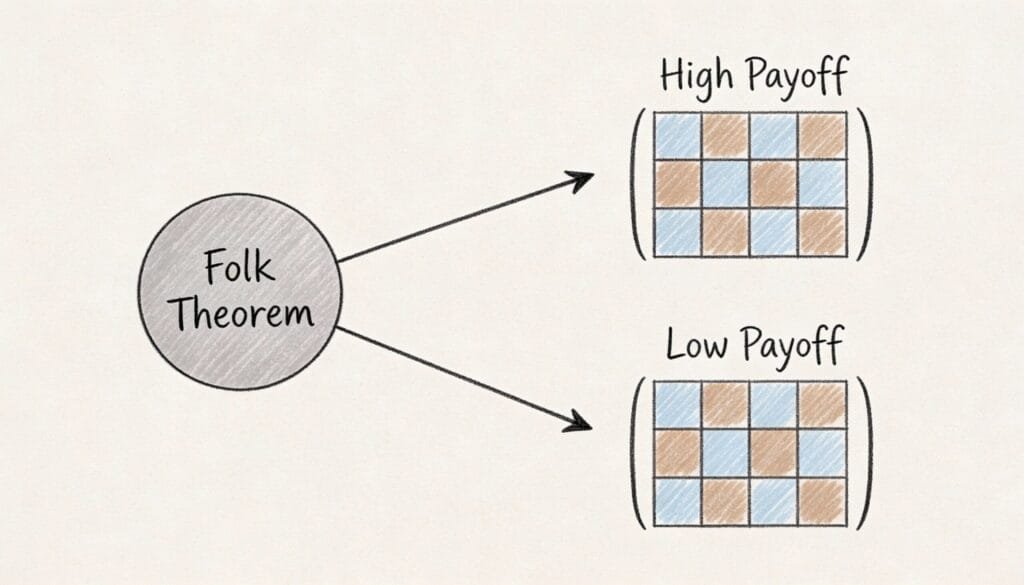
The Folk Theorem, stripped of formalism, says this: if people are patient enough, if they care sufficiently about the future, almost any outcome becomes possible in a repeated game. Cooperation, mutual defection, alternating patterns, bizarre cycles. All can emerge as stable equilibria sustained by threats and promises.
The mathematics requires just a few ingredients. Players must interact repeatedly with no known end date. They must value future payoffs enough that tomorrow matters almost as much as today. And they must be able to observe what others did in previous rounds.
Given these conditions, the theorem proves something counterintuitive. The grim single shot equilibrium loses its inevitability. New equilibria bloom like flowers after rain. Cooperation becomes sustainable through reputation.
The Mechanics of Forever
How does infinite repetition conjure cooperation from selfishness?
Consider a simple strategy called Grim Trigger. Start by cooperating. Continue cooperating as long as everyone else cooperates. But if anyone ever defects, switch to permanent defection forever. The name captures the mood. One transgression triggers an eternal grudge.
Sounds extreme. But the extremity serves a purpose. The threat must hurt enough to deter cheating. If a merchant knows that one act of selling junk will cause all other merchants to sell junk forever after, that single moment of extra profit costs an infinite stream of cooperative profits. The math tips toward honesty.
Other strategies work too. Tit for Tat does what the other player did last round. Defect, and you get defection in return. Cooperate, and cooperation flows back. The strategy builds a reputation for fairness and reciprocity.
Some strategies permit occasional forgiveness. Others demand extended punishment for single transgressions. The Folk Theorem proves that all these approaches can sustain cooperation, provided players value the future sufficiently.
The discount factor measures this patience mathematically. A player who values next period’s payoff at 90 percent of this period’s payoff has a discount factor of 0.9. Someone who values the future at 50 percent has a discount factor of 0.5. The Folk Theorem requires discount factors high enough that future losses from punishment outweigh present gains from cheating.
The Multiplicity Problem
Here emerges the theorem’s strange gift and curse. Too many equilibria exist.
Unlike most economic models that predict a single outcome, the Folk Theorem predicts everything and nothing. With sufficient patience, players can sustain nearly any pattern of behavior. Full cooperation works. Partial cooperation works. Alternating between cooperation and defection works. Even outcomes worse than the single shot equilibrium can persist.
Think about what this means. The mathematics cannot tell us which equilibrium will emerge. The model admits too many possibilities. Predicting actual behavior requires understanding cultural norms, historical precedents, focal points, or pure luck in coordination.
Some economists view this as a weakness. A theory that predicts everything predicts nothing. But others see profound insight. The multiplicity reflects reality. Societies do organize themselves differently. Markets develop different norms. Businesses build different reputations. The Folk Theorem doesn’t predict which path a community takes but shows that many paths exist.
This multiplicity also reveals why reputation systems are fragile. Multiple equilibria mean coordination problems. If everyone expects cooperation, cooperation emerges. If everyone expects defection, defection persists. Self fulfilling prophecies dominate. Trust, once lost, becomes hard to rebuild because the new equilibrium of mutual suspicion is equally stable.
Reputation as a Strategy
Reputation emerges naturally from the Folk Theorem’s logic. Reputation is simply others’ beliefs about what strategy someone follows.
A merchant with a reputation for honesty is believed to play a strategy that punishes his own cheating. Others expect him to maintain quality because they believe he values her long term standing. This belief makes cooperation with him worthwhile. The reputation becomes self reinforcing.
Building reputation requires consistency. The strategy must be observable. Others must see that promises are kept and threats carried out. Random fluctuations between cooperation and defection build no reputation because no pattern emerges to predict.
Reputation doesn’t require goodness. A reputation for ruthless retaliation serves as well as a reputation for kindness. What matters is predictability. Others need to know how someone will respond to actions. A known pattern of behavior, even harsh behavior, allows coordination.
Mafia organizations understood this. Reputation for brutal punishment of defectors sustained internal cooperation. The organization’s willingness to carry out extreme retaliation, even when costly, built a reputation that deterred future defection. Violence served as the strategy’s signaling mechanism.
Modern businesses play similar games with gentler tools. Companies spend fortunes building brand reputations for quality. The spending serves as a signal. A firm that invests heavily in reputation has more to lose from cheating. The investment itself makes the reputation credible.
The Finite Horizon Problem
The Folk Theorem requires infinite repetition. But nothing lasts forever. Every game eventually ends. Every business relationship terminates. Even civilizations fall.
What happens when the end approaches?
The mathematics turn grim again. With a known final round, cooperation unravels through backward induction. In the last interaction, no future exists to punish defection. So both players defect. But knowing the last round brings defection, the second to last round becomes effectively the last meaningful interaction. So defection spreads backward. The entire cooperative structure collapses.
This is the textbook result. Reality often deviates. Cooperation persists even in finitely repeated games. Several factors explain the discrepancy.
First, the exact ending often remains uncertain. Businesses don’t know precisely when a relationship will end. Employees don’t know their exact retirement date years in advance. Uncertainty about the horizon reintroduces elements of infinite repetition. Maybe there’s always one more round.
Second, people care about more than monetary payoffs. Social preferences, ethical values, and emotional satisfaction affect choices. Someone might cooperate in the final round simply because it feels right, regardless of strategic calculation.
Third, reputation effects spill across games. Cheating in one relationship damages reputation in others. A merchant who defrauds customers in his final year before retirement still cares about his legacy, his children’s prospects, or his standing in the community.
The pure Folk Theorem requires infinite repetition, but its spirit survives in the messy finite world where endings blur and motivations multiply.
The Information Problem
The Folk Theorem assumes perfect monitoring. Everyone knows what everyone else did. But reality offers fog.
When actions are only partially observable, sustaining cooperation becomes harder. If a merchant can’t be sure whether bad quality resulted from deliberate cheating or supply chain problems, punishment becomes risky. Punishing honest mistakes triggers retaliation, destroying cooperation.
This generates a tradeoff. Too much forgiveness and cheaters go unpunished. Too little forgiveness and random noise destroys cooperation. Optimal strategies balance these concerns, typically involving probabilistic punishment that increases with the severity of observed defection.
Modern reputation systems try to solve the monitoring problem through aggregation. Online platforms collect many observations. A single bad review might be a mistake or a malicious attack. But a pattern of bad reviews reveals genuine problems. The wisdom of crowds filters noise from signal.
Yet even aggregated systems face manipulation. Fake reviews, strategic voting, and coordinated attacks plague online reputation mechanisms. The monitoring problem never fully disappears. It just shifts form.
Applications Beyond Markets
The Folk Theorem extends far beyond merchant interactions.
International relations operate as repeated games. Countries deal with each other across centuries. Cooperation on trade, environmental protection, or arms control can be sustained through reputational mechanisms. A nation that violates agreements faces punishment through sanctions, isolation, or military response. The threat of long term consequences sustains cooperation where single shot logic would predict conflict.
But the multiplicity problem bites hard here. Different countries can lock into different equilibria. Some international systems achieve stable cooperation. Others descend into cycles of conflict and retaliation. Historical accidents, cultural factors, and random shocks determine which equilibrium emerges.
Social norms within communities reflect repeated game dynamics. People cooperate in neighborhoods, professional networks, and social groups because of reputational concerns. Violating norms brings social punishment that extends across many interactions. The Folk Theorem provides mathematical foundation for understanding how communities sustain prosocial behavior without formal enforcement.
The Trust Paradox
Here sits the deepest irony. Trust emerges from the mathematics of selfishness.
The Folk Theorem doesn’t require altruism, kindness, or moral virtue. Purely selfish actors, caring only about their own payoffs, can sustain cooperation through reputational mechanisms. The appearance of trust and reciprocity emerges from calculated self interest interacting with infinite horizons.
This seems cynical. Cooperation is just delayed defection, forestalled by future consequences. Reputation is just a tool for selfish gain.
Yet the outcome matches genuine cooperation functionally. Merchants who cooperate from calculated self interest deliver the same quality goods as merchants cooperating from moral commitment. The mathematics can’t distinguish motivations from outcomes.
Perhaps the paradox resolves through evolution. Societies that developed norms of trust and reciprocity outcompeted societies trapped in defection. Whether cooperation stems from calculation or character matters less than whether cooperation occurs. Natural selection and cultural evolution might have transformed calculated cooperation into genuine social preferences over generations.
Or perhaps humans never fully separate self interest from social concern. The Folk Theorem shows cooperation is rational, and knowing cooperation is rational makes it feel right. Mathematics and morality intertwine rather than oppose.
The Future of Reputation
Digital technologies amplify reputation mechanisms while creating new problems.
Online platforms enable massive reputation tracking. Every transaction gets rated. Every interaction leaves data. Sellers, buyers, drivers, passengers, hosts, and guests all accumulate reputational scores. The Folk Theorem’s logic operates at unprecedented scale.
But digital systems also enable escape. Creating new identities costs little online. A seller with bad reputation can simply start fresh under a new name. The infinite horizon collapses into finite segments as actors jump between identities.
Blockchain technologies attempt to solve this by making reputations harder to abandon. Permanent, distributed ledgers could lock identities to their histories. But privacy concerns and practical limitations constrain adoption.
Artificial intelligence introduces another wrinkle. As AI agents conduct transactions, negotiate contracts, and interact strategically, they too must build and maintain reputations. The Folk Theorem applies to artificial as well as human players. Designing AI to develop trustworthy reputations becomes crucial as automation spreads.
In the end, cooperation doesn’t require angels. Reputation doesn’t require righteousness. The mathematics of repetition can transform a world of selfish actors into a functioning society.
Understanding the Folk Theorem doesn’t provide easy answers. Tomorrow matters because tomorrow keeps coming. The shadow of the future shapes today’s choices. Reputation emerges from this logic, built from countless interactions projecting forward into time.
The Folk Theorem proves that this simple truth, that tomorrow matters, is enough to transform competition into cooperation, strangers into partners, and calculation into trust.