Table of Contents
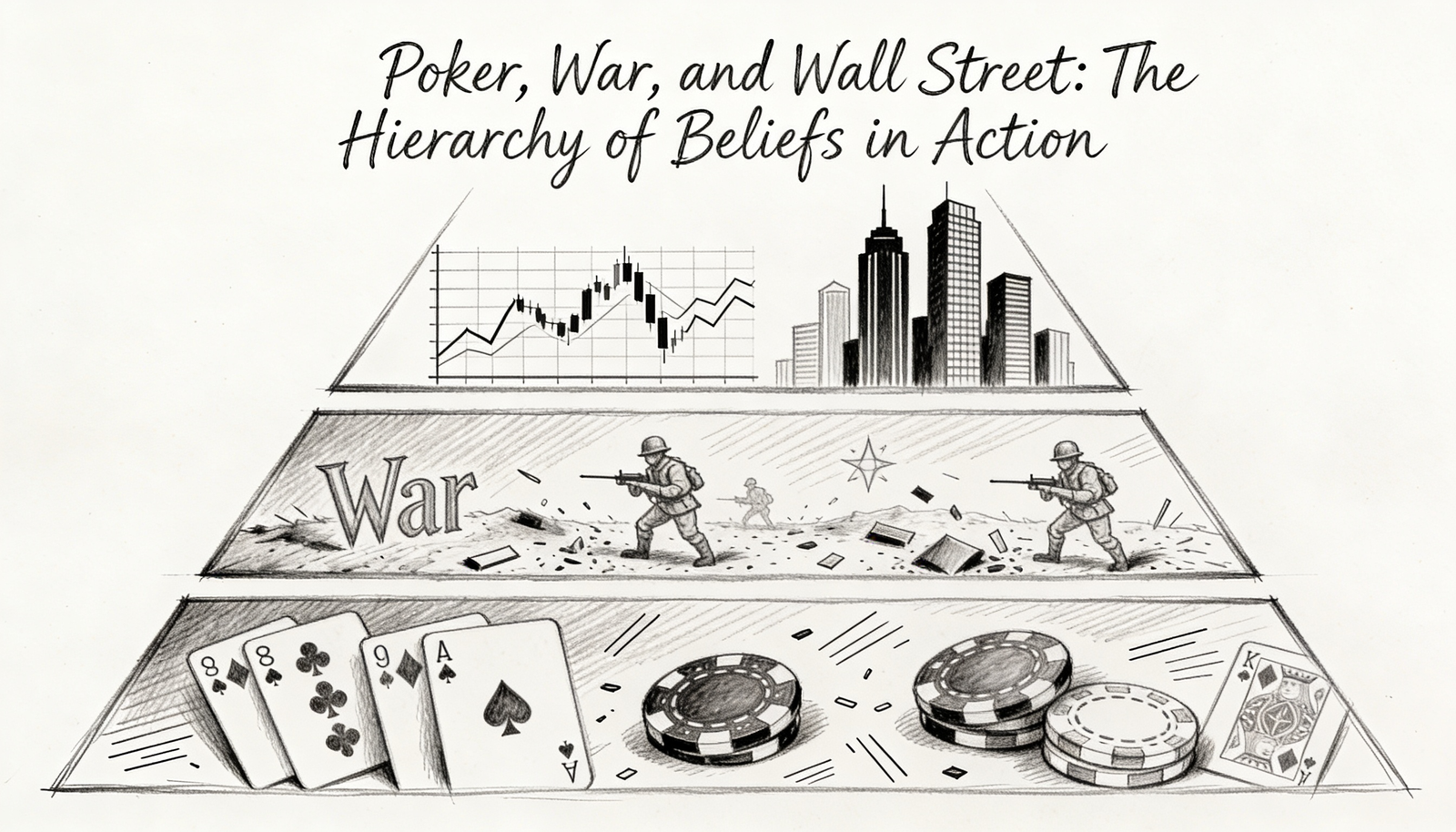
The poker player stares across the felt. The general studies the terrain map. The trader watches the ticker. Three different worlds, yet each player faces the same puzzle: what does the other side think that they think?
This recursive loop of strategic reasoning forms what game theorists call the hierarchy of beliefs. The concept sounds academic, but it explains why some people consistently win at poker, why certain military campaigns succeed against all odds, and why markets behave in ways that seem insane until you understand who’s thinking what about whom.
The Ladder of Minds
Imagine a game where everyone picks a number between zero and one hundred. The winner is whoever gets closest to two thirds of the average. What number would you pick?
Someone playing at level zero picks randomly. Maybe fifty, maybe seventy. They’re not really thinking.
A level one player reasons: “Most people will probably pick around fifty. Two thirds of fifty is about thirty three. I’ll pick that.”
But a level two player thinks: “Everyone will figure out the thirty three logic. So the average will be around thirty three. Two thirds of that is twenty two. That’s my pick.”
Level three goes deeper: “If everyone thinks like level two, the average drops to twenty two. Two thirds of that is about fifteen.”
This spiral continues downward until the only logical answer, assuming infinite levels of reasoning, is zero. Yet in real games, the winning number usually lands between fifteen and twenty five. Most humans operate between level two and level three. We think about what others think about what we think, then we stop.
The trick in poker, war, and finance isn’t reaching some theoretical maximum level. It’s correctly judging what level your opponent operates at, then positioning yourself exactly one step ahead.
Reading the Table
A professional poker player doesn’t just play cards. He plays opponents. The hierarchy of beliefs determines every significant decision at the table.
The novice at level one thinks only about his own hand. He holds pocket aces and gets excited. When someone raises, he re-raises because aces are strong. When that opponent goes all in, confusion sets in. How could they challenge aces? The level one player often loses everything because he never considered what his aggressive betting revealed to others.
The competent player operates at level two. He knows that poker is about ranges, not hands. When facing a raise, he doesn’t ask “do I have a good hand?” but “what hands would this opponent raise with in this position?” He’s modeling their thinking, playing against their likely holdings rather than just playing his own cards.
Then comes level three. The expert understands that smart opponents are also modeling his range. Every bet tells a story. When he checks, players are thinking about what hands he’d check with. When he bets, they’re narrowing down his possible holdings. So he deliberately does things that don’t make immediate sense at level two. He checks strong hands that “should” bet. He bets weak hands that “should” fold. These plays look wrong until you realize they’re exploiting opponents who expect level two logic.
The fascinating wrinkle: against a level one opponent, level three strategies backfire. If someone isn’t thinking about your thinking, your clever deception flies right past them. They call your bluff not because they detected it but because they weren’t thinking strategically at all. The best poker players are chameleons. They rapidly assess each opponent’s reasoning level and adjust to sit exactly one rung higher.
This creates strange dynamics. Sometimes the move that looks sophisticated loses money. A world champion might make plays at a casual home game that seem brilliant but actually spew chips to players who aren’t thinking deeply enough to fall for the trap.
Battlefields of Belief
Military history overflows with examples of the hierarchy in action. The general who wins isn’t always the one with more troops or better weapons. Victory goes to whoever most accurately models the enemy’s model of them.
Take the Battle of Cannae in 216 BC. Hannibal faced a Roman army nearly twice his size. A level one approach would be: “They have more soldiers, we’re probably going to lose.”
Level two: “They expect us to defend or retreat. If we attack in an unexpected way, we might surprise them.”
Hannibal went to level three. He knew the Romans knew Carthaginian armies typically used superior cavalry on the flanks. So the Romans would expect that. But Hannibal also knew the Roman commander Varro was aggressive and proud. The Romans wouldn’t just react to Carthaginian strengths. They’d try to use their numerical advantage to crush through the center where Hannibal appeared weakest.
So Hannibal gave them what they expected: weak center, strong flanks. The Romans saw this and did exactly what Hannibal predicted: they pushed hard into his center. As his center fell back, drawing the Romans deeper, his cavalry swept around from both flanks. The Romans found themselves surrounded. Of 86,000 Roman soldiers, perhaps 70,000 died. Hannibal lost around 6,000.
The genius wasn’t just predicting what the Romans would do. It was understanding that the Romans were predicting what he would do, then using that against them. He played level three against their level two.
Modern warfare shows the same patterns. D Day succeeded partly because the Allies convinced Germany that the invasion would come at Calais, not Normandy. But this wasn’t simple deception. The Germans knew the Allies would use deception. So the Allies created fake radio traffic, dummy equipment, and false intelligence. They built an entire phantom army that Germany’s reconnaissance could discover. The deception worked because it accounted for German attempts to see through deception.
The hierarchy creates a cat and mouse game. Once a tactic becomes expected, it stops working. Then the meta shifts. What was once clever becomes standard. What was standard becomes a trap for those who expect the new clever approach.
The Market’s Mind
Wall Street might seem purely mathematical. Numbers don’t think. Prices simply reflect value. But markets are made of humans (and algorithms programmed by humans) locked in a vast multiplayer game of strategic reasoning.
A level one investor looks at a company’s fundamentals. Revenue is growing. Profits look good. The stock seems cheap. Buy.
This can work in certain markets. If most participants are level zero (trading on emotion or noise), being rational puts you ahead. Warren Buffett made billions with what appears to be level one thinking: buy good companies at fair prices.
But notice the caveat: it works when others aren’t thinking this way. As markets became more efficient and everyone learned to read financial statements, pure fundamental analysis became table stakes. The game shifted.
Level two investors know that prices don’t just reflect value. They reflect what everyone thinks the value is. A stock might be fundamentally cheap, but if everyone expects it to get cheaper, it will. Momentum traders operate here. They don’t care about underlying value. They care about what others will think next week, next month, next quarter.
The dot com bubble showcased level two thinking run amok. Everyone knew internet stocks were overvalued by traditional metrics. But everyone also knew that everyone else was buying. As long as the music played, you made money not by being right about value but by being right about what others would do. Until suddenly the level shifted, the music stopped, and trillions evaporated.
Level three investors try to predict these shifts. George Soros made a fortune understanding reflexivity: markets don’t just reflect reality, they shape it. When everyone believes a currency will fall, they sell it, making it fall, confirming the belief. Smart traders don’t ask “what’s the fundamental value?” They ask “what do others think others think, and when will that feedback loop break?”
The 2008 financial crisis emerged partly from hierarchy failures. Big banks knew mortgage backed securities were risky. But they thought they could sell them to greater fools before the music stopped. Everyone was trying to be at level three, outsmarting everyone else. The problem: when everyone tries to be one level above everyone else, no one is actually supporting the foundation. The whole structure becomes a pyramid of beliefs with nothing underneath.
When Levels Collide
The hierarchy of beliefs reveals something counterintuitive: more thinking doesn’t always win. The optimal level depends entirely on what level your opponents occupy.
A poker professional playing against beginners should use level two strategies, not level three. Against weak players, straightforward value betting crushes fancy bluffs.
A general facing an unpredictable or irrational enemy can’t rely on level three reasoning. When Napoleon fought in Spain, the irregular guerrilla tactics confused his sophisticated military machine. The Spanish fighters weren’t playing a deep strategic game. They were operating more instinctively, making them paradoxically harder to model.
This creates a strange conclusion: you want to be exactly one level above average, not as high as possible. Going too high means you’re optimizing against opponents who don’t exist. You’re solving the wrong problem.
The Infinite Game
Here’s where things get recursive in an uncomfortable way. If everyone reads articles like this and learns about the hierarchy of beliefs, what level are we all at now?
Markets already show this evolution. Strategies that worked decades ago fail today because they became common knowledge. The famous “January effect” where stocks rose in January stopped working once everyone knew about it. The knowledge itself changed the game.
This is the Red Queen effect from evolutionary biology: you must keep running just to stay in place. In poker, war, and finance, you must keep evolving your level of thinking as others evolve theirs.
But there’s a limit. Human working memory constraints mean most people can’t reliably think beyond level three or four in real time. We can reason about it intellectually, but implementing it under pressure is different. The poker player has seconds to act. The general faces fog of war. The trader watches prices cascade.
So practical success comes not from reaching infinite recursion but from rapid level detection. The winners are those who quickly assess whether they’re facing level one, two, or three thinking, then adapt. Flexibility beats fixed sophistication.
Beyond the Game
The hierarchy of beliefs extends past poker rooms, battlefields, and trading floors. Negotiations, relationships, politics, every domain where humans strategically interact creates these cascading levels of reasoning.
A job interview isn’t just about answering questions well. It’s about modeling what the interviewer wants to hear, while knowing they’re modeling whether your answers are genuine or performed. But going too deep ruins it. Overthinking every word makes you seem calculated rather than authentic.
Dating shows the same dynamic. Trying to predict what someone wants makes you seem strategic rather than genuine. But being completely unaware of how you’re perceived seems clueless. The sweet spot sits between: authentic but aware.
Even parenting involves this dance. Children quickly learn what parents expect. Parents adapt to children learning this. The family becomes a system of mutual modeling, each person reasoning about what others think.
The question becomes: when should we think strategically about others’ thinking, and when should we just be direct?
The Wisdom of Simplicity
Perhaps the deepest insight is knowing when to abandon the hierarchy entirely. Some games reward sophistication. Others punish it.
In poker, against strong players, you need the hierarchy. In chess, you need it. In competitive business, you need it. These are adversarial games where someone wins and someone loses.
But many important parts of life aren’t zero sum. Relationships aren’t poker. When both people are trying to outthink each other, modeling what the other wants while hiding what they actually want, everyone loses. Sometimes level zero honesty beats level three strategy.
The same applies to certain market investments. Trying to time the market by predicting what others predict often underperforms simply buying and holding for decades. The sophisticated approach loses to the simple one.
The true skill isn’t reaching the highest level of strategic thinking. It’s knowing which situations reward strategic thinking and which reward something else entirely. The poker player who brings level three reasoning to a family dinner becomes insufferable. The general who can’t turn off tactical thinking makes poor peacetime decisions.
Understanding the hierarchy of beliefs means understanding its limits. Not every interaction is a game. Not every game requires playing the meta. Sometimes the best move is the obvious one.
The dealer shuffles the cards. The market opens. The armies march. And somewhere, someone is thinking about what someone else is thinking about what they think. They might win. Or they might be overthinking it.