Table of Contents
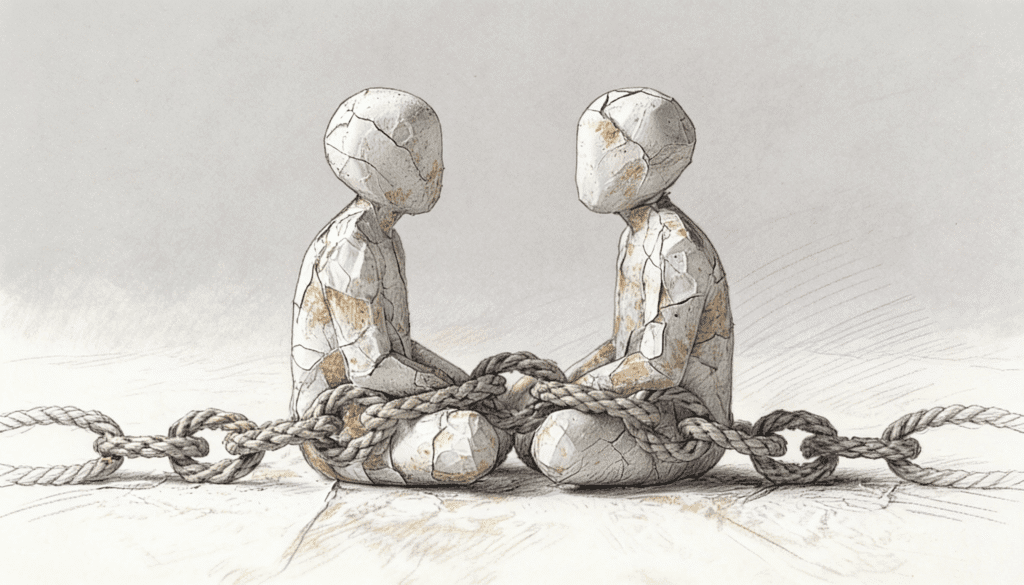
Here comes the deadlock. Two neighbors stand on opposite sides of a snowy driveway, each waiting for the other to shovel first. Neither wants to be the sucker who does all the work. Three hours later, both are still stuck at home. Welcome to the irony of caution: the very instinct designed to protect us can trap us in place.
The phrase “better safe than sorry” sounds like wisdom distilled to its essence. Who could argue with playing it safe? Yet this seemingly bulletproof logic contains a fatal flaw that game theory exposes with surgical precision. When everyone plays it safe simultaneously, the result is not safety at all. It is paralysis.
The Caution Trap
Picture a medieval village where every household keeps its grain locked away because bandits might come. The logic seems sound. Why share when theft is possible? But here is where mathematics becomes uncomfortable.
When every family hoards, no one trades. Without trade, specialization dies. Without specialization, the blacksmith cannot make better plows. Without better plows, harvests shrink. Everyone ends up with less grain than if they had taken the calculated risk of trading.
This is not a story about medieval villages. This is about every corporate meeting where no one shares the innovative idea that might get criticized. Every relationship where both people wait for the other to be vulnerable first. Every market where buyers and sellers both hold back, waiting for better terms, until the deal evaporates entirely.
Game theory gives this phenomenon a name: coordination failure. But the name does not capture the psychological sting. People are not failing to coordinate because they are stupid or lazy. They are failing to coordinate because they are being individually rational. That is what makes it tragic.
The Mathematics of Mutual Suspicion
Strip away the complexity and here is the skeleton of the problem. Two parties can both win big if they trust each other. But if one party trusts and the other defects, the trusting party loses spectacularly. The safe move? Do not trust. The problem? When both parties follow this logic, both end up with a mediocre outcome that neither wanted.
Game theorists call this the Stag Hunt, named after a Jean-Jacques Rousseau thought experiment. A group of hunters can work together to catch a stag, which provides meat for everyone. Or each hunter can break off alone to catch a rabbit, which feeds only that individual. The stag is better. But catching it requires coordination. If even one hunter chases a rabbit instead, the stag escapes and the remaining hunters go home empty handed.
The rational move when trust is uncertain? Chase the rabbit. It is safe. It is guaranteed. It is also suboptimal for everyone involved. This is better safe than sorry in equation form, and it creates deadlock with mathematical inevitability.
When Two Rights Make a Wrong
Here is where the psychology gets genuinely strange. Both parties are making the correct decision given their knowledge and incentives. Neither is being paranoid or unreasonable. Yet the collective outcome is worse than if both had made what appears to be the riskier choice.
Consider two companies that could benefit from sharing certain technologies. Company A would gain 10 points of value from cooperation. So would Company B. But if one company shares and the other steals the technology without reciprocating, the sharing company loses 5 points while the stealing company gains 15. If neither shares, both stay at 0.
The math is brutal. If Company A shares, Company B is better off stealing (15 points versus 10). If Company A does not share, Company B is better off not sharing either (0 points versus negative 5). No matter what Company A does, Company B’s best response is to not share. The same logic applies in reverse. Both companies end up at 0 when they could have been at 10.
This is not a failure of intelligence. It is a success of individual logic that creates collective failure. The better safe than sorry instinct is working exactly as designed.
It is protecting each party from the worst outcome. It is also preventing both parties from reaching the best outcome.
The Real World Does Not Deal in Abstractions
Strip the theory away and look at a recruitment scenario. A talented candidate interviews at a company. The candidate wants to know the real culture before accepting. The company wants to see genuine enthusiasm before making an offer. Both sides perform a careful dance, sharing calibrated information, neither willing to show their full hand first.
The candidate thinks: “If I seem too eager, they will lowball the salary offer.” The company thinks: “If we seem too interested, the candidate will make unreasonable demands.” Both parties protect their negotiating position. The result? The candidate accepts another offer where the enthusiasm felt mutual. The company hires a less qualified person who showed more interest. Better safe than sorry just cost both parties their optimal outcome.
Or take dating, that grand theater of strategic uncertainty. Two people enjoy each other’s company. Both wonder whether to escalate from casual to serious. Neither wants to be the one who cares more. Both wait for a signal from the other first. Weeks pass. The ambiguity becomes uncomfortable. Someone starts seeing other people as a hedge. The connection dissolves. What killed it? Not incompatibility. Mutual caution.
The Counter-Intuitive Solution
Common sense suggests that the cure for excessive caution is blind trust. Game theory suggests something more subtle. The cure is not to eliminate caution but to change the structure of the game itself.
Take the snowy driveway neighbors. The deadlock persists because shoveling first feels like being exploited. But what if the act of shoveling first created an obligation? What if the neighbor who shoveled first gained social standing while the neighbor who did nothing lost face? Suddenly the incentives shift. Shoveling first becomes a signal of strength rather than weakness.
This explains why small communities often cooperate better than large anonymous ones. In a village where everyone knows everyone, reputation matters. The person who defects today faces consequences tomorrow. The cost of being seen as untrustworthy exceeds the benefit of not shoveling. Better safe than sorry gives way to better cooperative than isolated.
But here is the truly counter-intuitive part. Sometimes the solution is not to make cooperation safer. It is to make defection more visible. Transparency, not safety, breaks the deadlock.
The Trust Tax
Every business negotiation, every diplomatic treaty, every partnership agreement carries what might be called a trust tax. This is the gap between what parties could achieve with full cooperation and what they actually achieve while protecting themselves from exploitation.
The trust tax shows up as legal fees for contracts that anticipate every possible betrayal. As corporate silos where departments hoard information and resources. As international relations where nations stockpile weapons not because they want war but because they fear being vulnerable to others who stockpile weapons.
The arms race is perhaps the most literal expression of better safe than sorry creating deadlock. Nation A builds weapons to feel secure. Nation B sees this and builds weapons to feel secure. Both nations end up less secure than before, having spent resources that could have built schools and hospitals. Neither nation is being irrational. Both are being individually rational in a way that produces collective madness.
The same dynamic plays out in less dramatic settings. Marketing departments keep customer insights from product teams. Product teams keep development plans from marketing departments. Both fear the other will take credit or misuse the information. The company’s products suffer because its own teams are playing better safe than sorry against each other.
Breaking the Stalemate
If mutual caution is individually rational but collectively harmful, how does anyone ever cooperate? Three mechanisms stand out.
First, repeated interaction. When the game is played once, defection is tempting. When the game repeats indefinitely, reputation becomes currency. The hunter who chased the rabbit instead of the stag might eat tonight, but next time no one will hunt with them.
Second, small first moves. Rather than requiring a giant leap of trust, successful cooperation often starts with a tiny step. A company shares something minor. If the other reciprocates, trust grows incrementally. Game theorists call this tit for tat, and it is surprisingly effective. Start cooperative. Match what the other party does. Forgive occasional defections. This simple strategy wins simulation tournaments against far more complex approaches.
Third, costly signals. When someone makes a move that would only make sense if cooperation was intended, it changes the calculation. A company that invests heavily in joint infrastructure before partnership terms are finalized is sending an expensive signal. It is harder to fake and thus more credible than cheap talk.
The Paradox of Vulnerability
Being the first to take a risk often feels dangerous. But being the first to take a risk is also a position of power. It defines the terms. It sets the tone. It forces the other party to respond rather than calculate.
Think of negotiations where both sides open cautiously with enormous gaps between positions. Hours of haggling follow. Compare this to negotiations where one side opens with a reasonable offer supported by clear logic. The other side often responds in kind. The first party did not weaken their position by being reasonable. They strengthened it by making cooperation feel possible.
The same applies to personal relationships. The person who is first to be genuinely vulnerable does not become exploitable. They become trusted. They create safety that allows the other person to reciprocate. Mutual guardedness creates mutual suspicion. Courageous honesty creates courageous honesty.
This does not mean being reckless. It means distinguishing between intelligent risk and fearful paralysis. The person who jumps off a cliff is not brave. They are foolish. But the person who refuses to cross any bridge because it might collapse is not safe. They are trapped.
When Caution Becomes Cowardice
There is a line, admittedly fuzzy, between prudence and paralysis. Checking both ways before crossing the street is prudent. Refusing to leave the house because cars exist is paralysis. Yet the logic is continuous. More checking is safer. Complete avoidance is safest. Where exactly does better safe than sorry become worse trapped than thriving?
Game theory suggests the line appears where defensive actions start imposing costs on future opportunities. Wearing a seatbelt is costless caution. Refusing to drive anywhere is costly caution. The first protects against downside without limiting upside. The second prevents downside but eliminates upside entirely.
The Cost of Protection
Consider the student who studies so carefully to avoid any confusion that they never engage with difficult material. They protect their grade point average. They sacrifice their education. Or the investor who diversifies so thoroughly to eliminate risk that their returns become mediocre. They protect their capital. They sacrifice their growth.
Better safe than sorry begins as risk management. It ends as opportunity management in reverse.
Game theory reveals something uncomfortable here. Some people are positioned to take risks. Others are not. The person with resources can afford to fail and try again. The person without resources cannot afford a single failure. Better safe than sorry is more expensive for some than others, which means coordination failures hit the vulnerable harder.
This creates a second order problem. Those who can afford risk take it and benefit from cooperation. Those who cannot afford risk play it safe and fall further behind. The gap widens not because of different abilities but different capacities to absorb the cost of being wrong.
The right balance between caution and courage depends on context, on stakes, on what we know about the other players. In a one shot game with strangers, caution makes sense. In a repeated game with known partners, courage pays off.
The person who always plays it safe will avoid disasters. They will also avoid their best possible outcomes. The person who always takes risks will achieve spectacular wins. They will also suffer spectacular losses.
That game requires distinguishing between situations where better safe than sorry prevents loss and situations where it creates deadlock. It requires noticing when mutual defensiveness is making everyone worse off.
The neighbors still stand on opposite sides of the snowy driveway. But now one of them picks up a shovel. Not because they are naive. Not because they trust the other completely. But because staying stuck is its own kind of risk, and sometimes better safe than sorry is just another name for safely stuck.